



































Almost every athlete enters a new season with a set of personal goals. Score 15 points per game. Lead the team in assists. Surpass last season’s scoring total. These are all worthwhile ambitions, the kind that get written down, stuck on mirrors, and revisited daily. But Sophie Cunningham approaches the concept of personal goal-setting from an altogether different angle.
Speaking on the Show Me Something podcast, which she co-hosts with her friend West Wilson, Cunningham laid out her philosophy on goal-setting in a refreshingly candid and thought-provoking way. “I think those are fun things to go after or like things that you would like to do, but at the end of the day, there’s so many people and it’s so political. Like, there’s so many people that are controlling all those strings of what am I doing to set myself up to be,” she said. In other words, while personal milestones are appealing on paper, many of the outcomes in professional sports are not entirely within a player’s hands.
She went further, using a concrete illustration to drive the point home. “I could say I want to be a top-three three-point shooter in our league. But I feel like there’s so much out of my control. Like you can’t control how much you get the ball. There’s too much outside of your control,” she explained. And she has a valid point. A player can be shooting at an elite percentage, putting in the work every day, and still fall short of a statistical ranking simply because shot opportunities aren’t coming her way. Outcome-based goals, by their nature, depend on variables that no individual player can fully dictate.
For Sophie Cunningham, the better alternative is a shift toward process-based goals, the kind that live entirely within her own control. “For me, my goal is what am I doing literally every single day in order to better myself. To stay healthy, to be in shape, to make sure I’m getting my shots in, to hit all this stuff,” she said. These daily commitments don’t change based on external factors, such as what the coaching staff decides in a given game. They are fully dependent on her own discipline and consistency, which is precisely why she trusts them.
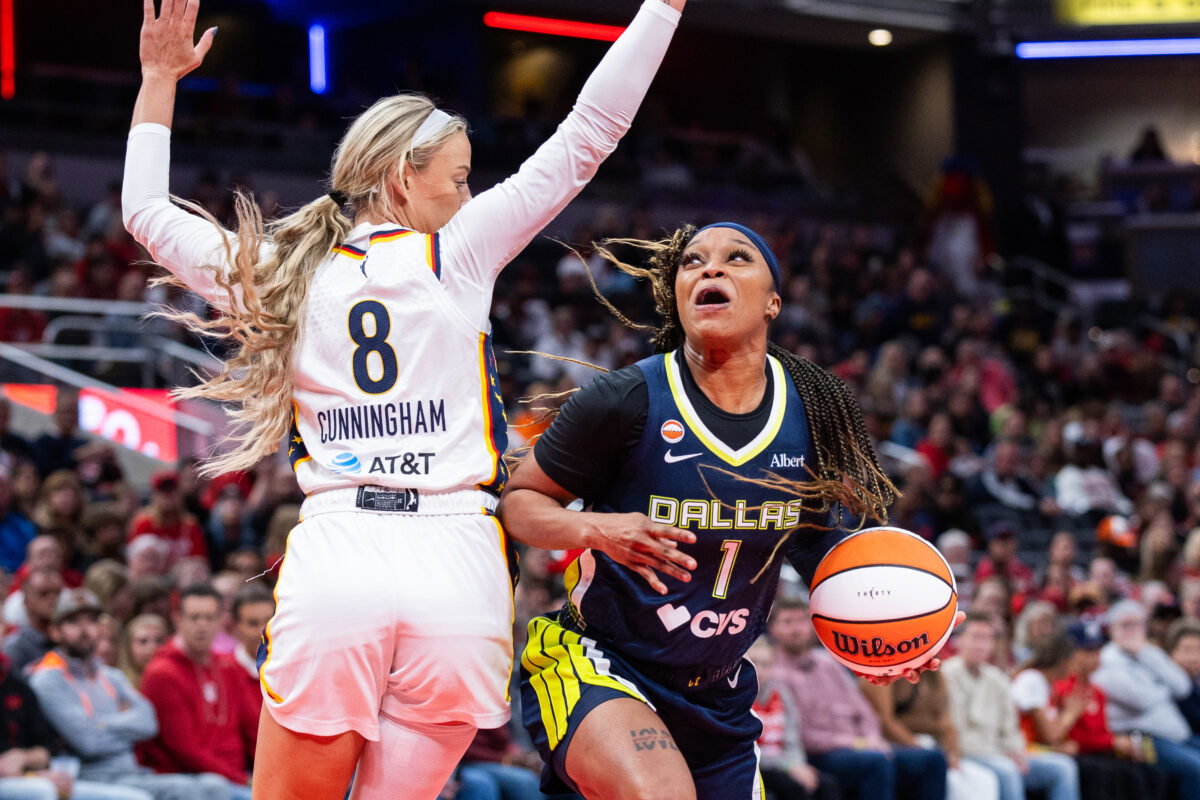
And for Cunningham, that daily discipline is the foundation on which everything else is built. As long as she holds herself accountable to those process goals every single day, she believes the results will take care of themselves. “I feel like I’m going to end up where I’m supposed to be. And I can control that,” she said.
Sophie Cunnigham has a genuinely compelling perspective. And it’s worth sitting with. But do you agree with Cunningham’s approach, or do you think outcome-based goals still have their place? Perhaps the sweet spot lies somewhere in between, using outcome goals as a motivational compass while leaning on daily process goals as the real engine of growth.
Sophie Cunningham Reveals Indiana Fever’s Major Defensive Goal Ahead of 2026 Season
After flaming out of the WNBA semifinals in 2025, the Indiana Fever are entering this season with a renewed ambition to go all the way. Caitlin Clark, the face of the franchise, has not attempted to temper that expectation. “I think we’re gonna be the favorite to win it all. I think it adds a little pressure, but that’s what you love about it,” she said.
One area the Fever have identified as central to that championship pursuit is their defense. And as Sophie Cunningham revealed, the goal now is to be the best defensively. “A team goal that I can share is I know that we want to be the best defensive team,” she said on the Show Me Something podcast.
Cunningham is also genuinely confident that the goal is within reach. “I think that is a very doable goal because it’s everything you can control. It’s all about communication. It’s about knowing your teammates, what they’re good at, what they’re bad at. I think we’re going to have a pretty good defensive team,” she said.
Indeed, for much of the 2025 season, the Fever ranked near the bottom of the league defensively. They also held the second-worst defensive rating in the league for a significant stretch of the year. So, this conscious effort towards improving the team’s defense is understandable. Part of that effort is selecting Raven Johnson in the WNBA Draft. As a former SEC Defensive Player of the Year at South Carolina, Raven was targeted to solidify Indiana’s point-of-attack defense.
Offense, for the most part, has never been a problem for this Fever team with Caitlin Clark, Kelsey Mitchell, and Aliyah Boston. These three form one of the most dynamic attacking combinations in the league. But in the postseason, when things get a bit tighter, offense alone has proven not to be enough. Fixing the defense may be the final piece that helps them go all the way.