


































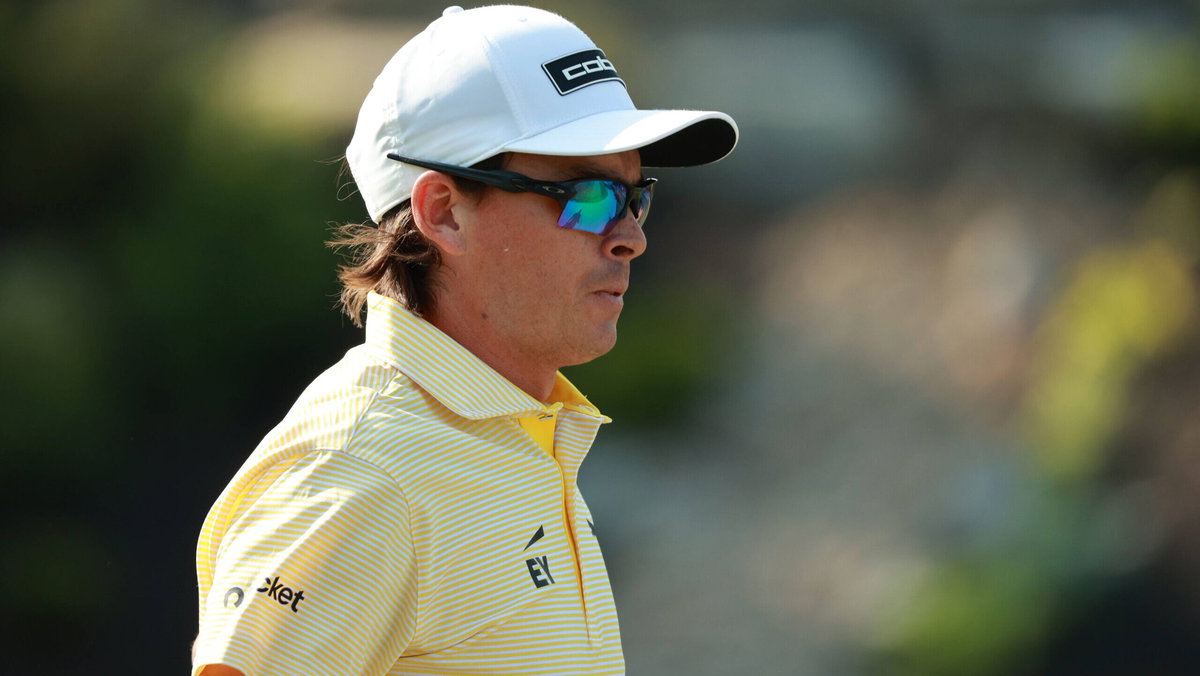
Rickie Fowler has heard the noise around Team USA for years. People have said the team is too friendly, too comfortable, and too focused on chemistry over competitiveness. While some see this as a negative sign, Rickie Fowler thinks otherwise. The American pro joined our representative, Andrew Whitelaw, for an EssentiallySports exclusive interview and shared his thoughts.
“Defining characteristic. I feel like we’re all, I mean, we’re all like good buddies or best friends. I feel like sometimes people take that and spin it as if it’s a negative thing for the team. But I would almost argue that over the last 10-20 years, they’ve been some of the closest group of guys versus the past,” Rickie Fowler told EssentiallySports when asked about the ethos and the biggest defining characteristic of the American golf team.
“I wasn’t on those teams way back when, but I feel like the camaraderie, the friendships, and the closeness of the teams have continued to get even tighter and tighter.”
Rickie Fowler debuted in international team events as a teenager and played in the Walker Cup 2007 and the World Amateur Team Championship 2008. Then, he played in the Ryder Cup in 2010, 2014, 2016, 2018, and again in 2023. He is someone who can be described as the longest‑running connector between older and newer generations of Team USA. If he says that he can visibly see the change, his words carry weight.
In the recent past, the golf world has repeatedly framed Team USA’s buddy‑buddy vibe as soft, and it has been implied that the team lacks the similar grit as Europe’s. Detractors have painted this team camaraderie as a liability. According to them, they are nice to each other but not hard-nosed or emotionally connected like Team Europe. Some reports even claim that the team members are focusing more on individual brands and personal achievements rather than collective sacrifice.
Most pros who play in the Ryder Cup have been playing on the Tour for a substantial time; they are good friends with each other. Take Justin Thomas, Jordan Spieth, and Fowler, for example. They are still considered one of the tightest groups on the PGA Tour. They were also spotted together at Wimbledon in 2023, enjoying the competition.
“I said it before the event; I thought this was the closest team that I think I’ve been on,” Brooks Koepka told a press conference.
Justin Thomas agreed. “We truly all got along, we clicked,” he said. Justin Leonard and others echoed that the camaraderie was genuine and unusually tight.
Ahead of Bethpage Black, Keegan Bradley also leaned on this chemistry. The team had gathered at Silverado for the Procore Championship. From there, they used practice rounds, dinners, and informal sessions to test pairings and build rapport.
While this is something Rickie Fowler has been seeing in the American team since the last two biennial events, Team Europe has focused on this aspect for several years now.
Camaraderie in the European team for the Ryder Cup
Many professionals playing in the European team have expressed their camaraderie very well. For instance, during the 2016 Ryder Cup, Sergio Garcia said that when he looks at their locker room, he can’t find a single professional he would be uncomfortable playing with.
According to him, that bond between the professionals is something facilitated by the DP World Tour. He said that golfers share rooms with fellow pros on the DP World Tour. However, that does not happen often on the PGA Tour.
Danny Willett also said the same about the foundation of their team spirit. The English professional noted that playing together in Europe adds to the team’s environment.
After losing at Whistling Straits in 2021, Rory McIlroy, in a tearful TV interview, pointed out that the European team is not only together in champagne‑spraying highs but also in the painful lows.
“There’s nothing more special than being part of these teams,” he had said.
Many others, including Jon Rahm, Tommy Fleetwood, and Viktor Hovland, have said something similar about their team bonding.
The European team’s long-standing culture of shared experiences shows how strong chemistry can become a competitive advantage. Fowler’s comments reflect a similar shift within Team USA. Team management and professionals now view tighter bonds as a foundation for stronger performance rather than a flaw.