













After losing their fourth game to the Oklahoma City Thunder, the Los Angeles Lakers were officially eliminated from the 2026 NBA Playoffs. The Purple and Gold definitely deserve some flowers for how they handled this postseason. Everyone expected them to lose against the Houston Rockets, whom they easily defeated. While they were unable to steal a game from the Thunder, they did bring the game within single digits in the second half of each of their games.
However, when you are the greatest franchise in modern basketball history, making a one-seed sort of kinda sweat isn’t enough. Especially not when you have a perennial MVP candidate in Luka Doncic and have yet to build a proper roster around him. This summer marks the first time Los Angeles will have the opportunity to create a unit that is sympathetic to Doncic’s strengths and weaknesses.
But, before they outsource those jobs to players who aren’t currently on their roster, Los Angeles should look in the mirror to see who they already have who can help the Slovenian wunderkind enter the annals of Lakers history. Here are four men who match that description.
The Lakers Should Not Bring Back LeBron James
Spoiler alert: the owner of the greatest career in NBA history should not be brought back by the Lakers next season. From a public relations standpoint, Los Angeles kind of has to hope that James retires or opts to carry out his swan song elsewhere because not bringing the GOAT back would be a terrible look – particularly after his heroics this postseason.
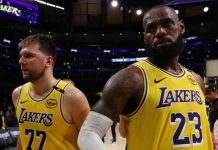
As we’ve hinted at before, James and Doncic have overlapping skillsets. Doncic excels at playing with the ball in his hands and making most of his team’s primary decisions, and part of the reason James was able to turn back the clock so much was that he got to be head of the control tower again.
The best way to quantify this is by looking at the team’s plus-minus combinations involving these two. When Doncic is on the floor with James, the Lakers have just a net rating of +0.77 per 100 possessions (per PBP Stats). That is far lower than the Lakers’ net rating when Doncic is riding solo (+7.18 per 100) or when James is on his lonesome (+5.58 per 100).
Even if James takes the veteran minimum, the Lakers would need to play him. And playing James comes with the opportunity cost of forfeiting precious time that could be allocated to players who better complement Doncic’s skillset.
#1: Austin Reaves
After a rough start to his 2026 postseason, Austin Reaves reminded us why he is a worthy second fiddle to Doncic. In his final three games, against arguably the best defense of the last decade and a half, Reaves averaged 25 PPG and 7 APG on 65.9% true shooting.
Reaves’ ability to scale up when his co-stars are out of the rotation has been well-documented at this point. But what truly makes him a perfect partner to Doncic is his ability to oscillate between playing on and off the ball like Kyrie Irving did when #77 was still playing for the Dallas Mavericks.
Do you remember how unspectacular the Lakers were when James and Doncic shared the floor this season? Well, when Doncic shared the floor with Reaves (and James is on the bench), the Lakers had an outstanding 10.36 net rating.
Reaves is going to decline his player option ($14.9 million) for 2026-27 because his production is worth far more than that, even with his injuries (he missed 31 regular season games), my formula estimates that the combo guard should make $29.3 million next season. If Reaves is able to stay healthy like he did in 2024-25 (when he played in 73 games), his estimated production is closer to 40 million dollars.
So long as the Lakers don’t get hung up on trying to accommodate to what James’ salary demands may or may not be, they should have no trouble retaining Reaves, even if it is a near-max contract he desires. And they better prioritize doing so because, after Doncic, he is the most important player on this roster.
#2: Rui Hachimura
A few times now, I’ve mentioned that the Lakers need to prioritize players who are compatible with the way that Doncic likes to play. What that means is surrounding him with as much size, defense, shooting, and interior play-finishing as possible.
At 6’8 with the right dose of brawn for playoff level physicality, Rui Hachimura screams credible starting forward option next to Doncic. This is without mentioning that Hachimura has basically been Robert Horry since putting on a Lakers uniform – hitting 50.7% of his 142 playoff threes over the last four years.
Hachimura is a free agent coming off a playoffs where he averaged a career-high 17.5 PPG and played an integral role in helping pull off an improbable series victory over the Rockets. This has all the makings of a huge payday for Hachimura this offseason, and the Lakers probably can’t afford to prioritize him in the same way they can with Reaves.
What the Lakers do have going for them is the promise of starting on the most popular team in the association, alongside a player capable of serving up open looks on a silver platter, and playing for a coach who knows how to get the most out of him in JJ Redick. Hopefully, that is enough to make him give Los Angeles a hometown discount because replacing Hachimura is going to be a tall task for the Purple and Gold.
#3: Marcus Smart
Historically, defense-first guards don’t age well because they don’t have the size that bigs (like Rudy Gobert) have to fall back on once their athleticism wanes. After two injury-plagued seasons with the Memphis Grizzlies and Washington Wizards, I thought the 32-year-old Marcus Smart was done being an impact player. But man, did the former DPOY hit me with one heck of a f*** you, Mat Issa, as Smart led the team in on-off point differential during the regular season and then proceeded to log 34.5 MPG in ten grueling postseason games.
Smart has a $5.4 million dollar player option, but after his renaissance campaign, his representation is going to want to try and cash in on one last lucrative deal. Los Angeles is going to want to get younger around Doncic. That’s why I think it’s time to let James ride off into the sunset. But Smart is the exact veteran role player that you want to go to war with, and that’s exactly what the deep rounds of the playoffs are: a war. If the Lakers can somehow get the soon-to-be 13-year veteran for under $20 million a year, they need to jump at that opportunity.
#4: Luke Kennard
In many ways, Luke Kennard is the antithesis of everything we have been talking about. He isn’t tall/long (6’5 with a matching wingspan), is a moving target on defense (17th percentile Defensive Estimated Plus-Minus, per Dunks & Threes), and hardly ever takes shots at the rim (10th percentile in attempts per 75). Before being traded to the Lakers at the deadline, he hardly factored in Quin Snyder’s rotation with the Atlanta Hawks. Heck, even Redick (who likely sees a lot of himself in Kennard) was forced to play the lefty marksmen less in Round Two (27 MPG) than he did against the Rockets (36.3 MPG).
The good news is that NBA teams are smarter than ever before. Everyone knows that Kennard’s limitations prohibit him from being a key cog in a playoff rotation. So, the Lakers likely won’t need to break the bank to retain the unrestricted free agent. But why would Los Angeles, who ostensibly wants to build a title contender around Doncic, want such a limited player? Simple, Doncic is going to miss time during the regular season, and Kennard’s tremendous shooting (career 44.2% from three) and ability to operate in Redick’s system make him the perfect regular season innings eater.