














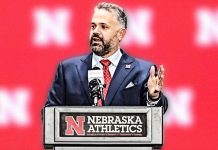







Nebraska hadn’t won a Bowl game since 2015, and now it has made it to bowl games for two consecutive years. What remains is accomplishing a double-digit season, something the program hasn’t done since 2012. In doing so, the Cornhuskers will also kindle their hope for a CFP berth and potentially a national championship, something the program hasn’t won since 1993. But for that to happen, Matt Rhule needs unprecedented investment.
“If you want to play at that level, if you want to play at the CFP level, you have to invest CFP money,” Matt Rhule said on Adam Breneman’s May 12 podcast. The Peed family opened up the Collective 1890, and has worked to get us where we want to be. But as we’re doing that, other people are being aggressive too, and you can see the impact.”
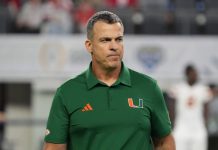
Rhule highlighted examples of programs like Miami, Texas A&M, and Texas, and how their NIL investment paid off massive dividends. Miami, for instance, didn’t have a 10-win season for “15 or so years,” but with the NIL push and heavy roster investments, it compiled back-to-back double-digit seasons. Similarly, for Matt Rhule, Texas A&M always lagged ever since “Johnny Manziel,” but with the right investment, they made it to the 12-team playoff last year.
Matt Rhule’s stance regarding NIL investment in his roster remains clear. Without significant investment, it’s almost impossible to make it to the playoffs. Something other programs seem to be doing comfortably year after year. Despite that demand, Rhule praised Nebraska’s Athletic Director, Troy Dannen, for his aggressive NIL efforts and fundraising efforts and the job the Lincoln program is doing to help Rhule.
Matt Rhule (@CoachMattRhule) is widely regarded as one of the best builders of culture in the world.
Much of his philosophy with @HuskerFootball was shaped by his experience as a walk-on at Penn State, where he learned three foundational truths:
1. “Everything Matters”.
2.… pic.twitter.com/QavtMaVKWu— Josh Chambers (@JoshChambers) May 13, 2026
“We went through this year. Troy Dannen, AD, really made a commitment along with Jeff Gold (Nebraska’s president) to ‘hey, let’s invest the resources to get Nebraska to that level,” Rhule said. “I’ll say this: the mark continues to move. And so I have my part of my job, which was not my job in other places, is to continually go outside and find ways to gain resources. And I think that’s what’s really cool about Nebraska…”
Dannen came in 2024 and has aggressively revamped the program’s ‘1890 Nebraska’ collective. The Athletic Department has given the collective its full backing and has made tax-deductible contributions to it. Additionally, the state’s governor, Jim Pillen, also signed the Legislature Bill 1393 into law in June 2024, which eventually allowed the program to create one of the most aggressive NIL programs in the country. In two years, the collective has flourished.
“We are grateful,” Rhule said about Dannen’s efforts. “Troy’s worked really hard. Troy Dannen’s worked really hard to get us in a position where we’re hopefully within striking distance of some of those other teams. This’ll be the first year we can do whatever we…we have the money now. I can’t complain anymore. We got what we need.”
Backed by Nebraska businessmen Tom Peed and Shawn Peed, the 1890 Collective has truly flourished in a short time. As a result of the efforts, the program inked a $10.25 million NIL collective deal with Playfly Sports.
Playfly was the Cornhuskers’ multimedia rights partner, and the program’s Board of Regents approved the move last December. Although it faced some enforcement challenges with players’ contracts, those challenges were eventually resolved. In all, the Cornhuskers are doing everything to put Nebraska in playoff contention. But despite that, the gap between them and the blueboods is ever-increasing.
Can Nebraska ever close down that $16 million roster investment gap?
Matt Rhule is on a whopping $74 million contract and is in his fourth season with the Cornhuskers, having compiled a 19-19 record. Nebraska is the 17th-most-valuable program, valued at $930 million (per Athletic), and has an annual average football revenue of $116.3 million (second in the Big Ten). However, the program still lags behind blue bloods in NIL investment every year.
“I think we have had more than we ever have,” Matt Rhule said. “But as we’ve ascended, other people have certainly ascended, right? Sometimes people ask me, ‘Why didn’t we do this? Why did we do that?’ And there’s a finite amount of dollars that are available. But there are $40-50 million rosters in 2026 in college football.”
Last week, a report from HuskerOnline confirmed that the program’s roster spending for the 2026 season is $16 million behind OSU, Indiana, and other Big 10 rivals. Combined with revenue sharing and NIL investment, Nebraska was going to invest $25 million to $30 million in its roster this year. But at the same time, Oregon and OSU have spent over $50 million on their rosters, and even Indiana has reached $45 million.
Despite unprecedented investment for Rhule, just when Nebraska takes a step up, other programs leap forward 10 steps. Will it be a vicious cycle, or can Nebraska build a championship roster with what it has?