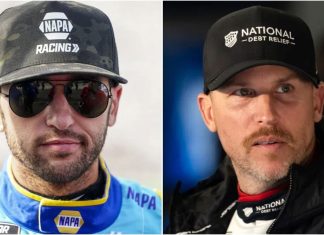


















Ryan Blaney has spent the last two NASCAR seasons driving like a championship favorite while living through one disaster after another. One week, the engine doesn’t perform. Another week, pit road buries him. Sometimes, it is plain bad timing. Yet, somehow, the No. 12 car keeps showing up near the front anyway.
That is why Blaney sounded less worried about speed and more worried about survival while discussing the NASCAR All-Star Race at Dover. With $1 million waiting at the end and desperate drivers fighting for transfer spots, he knows exactly how messy things can get when people stop thinking about points and start thinking about one shot at a payday.
Ryan Blaney Expects Desperation to Change the Race
Speaking with reporter John Newby before All-Star weekend, Blaney admitted the biggest challenge may simply be staying out of trouble early.
“So, Ryan, I’m kind of curious with how you approach the first two segments of the All-Star Race,” Newby asked. “Because I know you have a guaranteed spot in the final segment, but all the Open drivers are going to be trying to get their own spots.”
“Yeah, I don’t know. That’s a great question,” he said. “I hope you don’t get run over by some of those guys that need to get in. You know, no matter where you start, where you re-rack in the second run of the race, it’s all about trying to optimize your finishing position. I’ll be aware of who’s not locked in.”
Then came the part that really mattered.
“This person might be desperate to get in,” Blaney added. “They have to do everything they need to do to go try to race for a million dollars.”
“It’s just a harder race than every week,” he said. “Guys are willing to do a little bit more because they don’t have to worry about points.”
#NASCAR – Past seasons have featured the All-Star drivers sitting back and watching the Open drivers battle for the remaining spots. Some wrecks have happened.
This year, the entire field is together. So, how does Ryan Blaney avoid being taken out by desperate moves? pic.twitter.com/4setZtvaET— John Newby (@JohnNewby_) May 12, 2026
Well, previous editions of the All-Star Race ran a separate All-Star Open beforehand, where non-qualified drivers raced among themselves for a handful of transfer spots before the locked-in field took over the main event. The two groups never shared the same racetrack at the same time. And Dover 2026 has eliminated that.
Under the old Open format, the desperation was contained in a separate race. Here, it bleeds directly into Segments 1 and 2, where an Open driver scrapping for a transfer knows that a bad Segment 1 finish has to be overcome. And Blaney understands what that creates: “It’s a little bit different than what we’ve seen for sure with the whole field being grouped together, which is interesting, but it’s part of racing every week.”
And without points on the line for anyone: “It’s just a harder race than every week. Guys are willing to do a little bit more because they don’t have to worry about points.”
Add to this that the starting order for the Final is shaped by those same Segment results. A locked-in driver who sleepwalks through Segments 1 and 2 to protect their car could start deep in the field for the 200-lap run that decides the million.
Moreover, Ryan Blaney understands the intensity of that desperation because chaos has followed him for nearly two years. At Gateway in June 2024, he led by more than two seconds coming to the white flag before the car suddenly ran dry. Austin Cindric passed him for the win while Blaney coasted home 24th. Team Penske later traced the problem to a tiny fuel-density miscalculation in the summer heat.
Three months later, at Watkins Glen, his playoff race ended before Lap 1 was complete. A crash in the Bus Stop chicane damaged the steering, and NASCAR officials towed the car directly to the garage under the Damaged Vehicle Policy, which automatically ended his day. Then came the brutal stretch in 2025.
At Talladega in April, Blaney was entering pit road on Lap 43 when Kyle Busch and Brad Keselowski crashed directly into his lane. The hit destroyed the tow link and brakes. Another DNF.
At Pocono that June, his cooling suit failed on Lap 15. Cockpit temperatures climbed above 120 degrees, but Blaney stayed in the car and still finished third. After climbing out, he collapsed three times on pit road from heat exhaustion.
Even this season, the problems have not stopped. During the April race at Kansas, contact with AJ Allmendinger damaged the front splitter exiting pit road. Seconds later, the No. 12 team got hit with a “too many men over the wall” penalty. A top-five car disappeared into traffic almost instantly.
So when Ryan Blaney talks about being aware of desperate drivers around him, it comes from experience. That tension inside the No. 12 team becomes even clearer once you look at what is happening under the hood at Penske.
Team Penske’s Ford Setup Gives Blaney Speed and Headaches
Statistically, Blaney has been Penske’s fastest driver in 2026. He sits fourth in points with 405, already owns a playoff spot thanks to his Phoenix win, and ranks near the top of the series in green-flag passing.
The frustrating part is that his finishes still do not match the speed.
All three Penske cars use the Ford Mustang Dark Horse body and Doug Yates-built engines. But the setups are completely different. Joey Logano’s team leans conservative and stable. Austin Cindric’s car is balanced. Blaney’s No. 12 crew goes the opposite direction. They go for speed.
Blaney likes a loose race car that rotates aggressively through the corner and launches hard off the exit. That setup creates speed, especially on intermediate tracks, but it also pushes the Ford platform closer to the limit mechanically.
That aggressive philosophy partly explains the bizarre engine failures he suffered at Phoenix and Homestead-Miami in 2025. The No. 12 car ran tighter cooling windows and more aggressive aerodynamic tape than the other Penske Fords. The extra downforce created speed but also raised engine temperatures into dangerous territory.
Logano and Cindric finished those races cleanly. Blaney’s engine exploded twice. The same thing happened at Kansas earlier this year. The contact with Allmendinger only slightly bent the splitter, but the Ford Dark Horse underbody is extremely sensitive aerodynamically.
Even small splitter damage can ruin airflow and balance. The No. 12 team had to make multiple repair stops while the race slipped away. That has become the theme of Blaney’s recent seasons.
Through the opening races of 2026, his pit crew has already lost a net 88 positions on pit road, the worst in the Cup Series. Yet despite all of it, Blaney still keeps driving back through the field almost every week.
Which is why Dover feels dangerous for him in a different way. The speed will probably be there again. The bigger question is whether all that around him stays controlled long enough for it to matter.