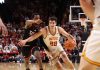









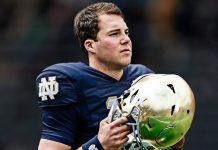









One of the most recent shocking changes in the world of football is that you can make as much dough as in the NFL in college football, all thanks to the golden era of NIL. Unless you are a top 5 or top 10 pick, it might come across as a bit ironic because the NFL was sold as the final destination and the big league. The former Notre Dame QB, Riley Leonard, is the latest victim in this case.
In a recent sit-down with The Athletic, Leonard admitted that leaving South Bend for the Indianapolis Colts meant watching his income actually drop.
While Leonard hasn’t posted his tax returns for the world to see, the grapevine says his Notre Dame NIL package was hovering somewhere between $1.1 million and $1.5 million annually. To put that in perspective, he mentioned that when he transferred from Duke to Notre Dame, his income spiked by over 10 times what he was making in the ACC.
Now that he’s on a rookie contract with the Colts, the math gets a little depressing if you’re a fan of his bank account. Because he was a 6th-round pick (number 189 overall), his four-year contract is worth about $4.4 million. On paper, that’s $1.1 million a year, which sounds like he’s breaking even, right? Wrong. In the NFL, “total value” is a bit of a mirage or even fugazi.
Riley Leonard is making less money in the NFL than with Notre Dame
pic.twitter.com/CIXc3UkmgW
— College Football Alerts (@CFBAlerts_) April 19, 2026
Leonard pointed out that the real kicker is the lack of guaranteed money. In college, those NIL checks were pretty much a sure thing as long as he was on campus. In the NFL, he’s basically on a year-to-year trial basis where the team can cut ties without losing much sleep.
Leonard pointed out that the biggest “catch” is that only about $235,000 of his NFL deal is actually guaranteed as a signing bonus. It’s honestly wild to think about a guy who was just three plays away from winning the natty 13 months ago barely makes $200K—before taxes. If you add in federal tax, Indiana state tax, and jock tax (the taxes that NFL players pay in every state they play games – away games basically), the take-home money would be in the vicinity of $110K to $125K.
However, he’s not the only one feeling the pinch, either; other rookies like former Ohio State QB Will Howard have said the same thing the other day. No wonder the likes of Trinidad Chambliss fought for four months in court for his 6th year of eligibility. Maybe that’s the price to play in the NFL. Sometimes you have to take a temporary pay cut to chase the dream of a big, fat second contract in the NFL later on, if you are lucky.
Why milking college football is a good thing for a player?
This milking of college money is the newest and wildest trend in sports, and honestly, it’s just smart business. The biggest reason players are sticking around is that college boosters and “collectives” are writing checks that can rival an NFL rookie’s base salary.
For example, let’s take a deep look into the Chambliss case. The former Ole Miss baller was projected to earn between $5 million and $6 million in NIL money for the 2026 season. Compare that to the NFL’s rookie scale, where a mid-to-late round draft pick might only see a base salary of about $840K if the football gods are feeling generous.
Some players, like Carson Beck, have even “undeclared” from the draft or used the transfer portal specifically to find a school willing to pay them a higher NIL rate for one final season. It’s a no-brainer: by staying in college, not only do you make generational money, but you also improve your stock for the upcoming draft.