




































A Cleveland radio appearance this week cut through the usual layers of NBA rumor and restraint. Bill Reiter didn’t frame his comments as speculation or secondhand noise. He drew a hard line instead, insisting the dynamic between LeBron James and Luka Doncic is not as stable as it looks from the outside, and that, in his view, the relationship is already strained. Now, in the aftermath of a sweep at the hands of the Oklahoma City Thunder, Bill’s close ties to both cities have decided the full picture can no longer be ignored.
Bill Reiter, speaking on 92.3 The Fan in Cleveland, did not couch his remarks as rumor or speculation. He made a distinction that matters:
“I think that LeBron and Luka don’t get along very well. And I think that, in fact, I know that they don’t get along very well.” He pre-emptively addressed his credibility on the LeBron side: “I like LeBron. I can qualify this because sometimes he loves me, sometimes he tolerates me, and sometimes he hates me. I think we’re in a hate phase right now on that side of the equation. But I respect the hell out of him.”
The admission signaled source proximity.
“I know (LeBron and Luka) don’t get along very well. (LeBron) doesn’t do well when he’s in a locker room that’s toxic. I would imagine that being in Cleveland with James Harden who he’s close to, with Donovan Mitchell…I just think it would be a happier place for LeBron as a… https://t.co/jP3ciAsVGI pic.twitter.com/XgU78kSZNx
— 92.3 The Fan (@923TheFan) May 11, 2026
Reiter’s core argument rested on a dynamic that anyone who has watched LeBron James move through his career recognizes immediately.
That kind of blunt assessment didn’t emerge in a vacuum. Around the league, LeBron’s partnerships have repeatedly followed a familiar arc – early alignment, rising tension, and eventual structural strain when roles stop fitting cleanly.
From Miami’s late-stage recalibration with Dwyane Wade, to Cleveland’s second stint, where Kyrie Irving’s departure reshaped the entire franchise, and even the final Lakers years before the Westbrook experiment collapsed, the pattern has been less about personality clashes than about competing definitions of control.
“He doesn’t do well when he’s in a locker room that is toxic. And it doesn’t go well when he is a part of that toxicity.”
In that sense, Reiter’s framing taps into a broader NBA reality: even elite partnerships tend to fracture not through open conflict, but through gradual role imbalance. When offensive hierarchy, leadership voice, and late-game responsibility stop aligning, chemistry can erode long before it becomes visible in the standings.
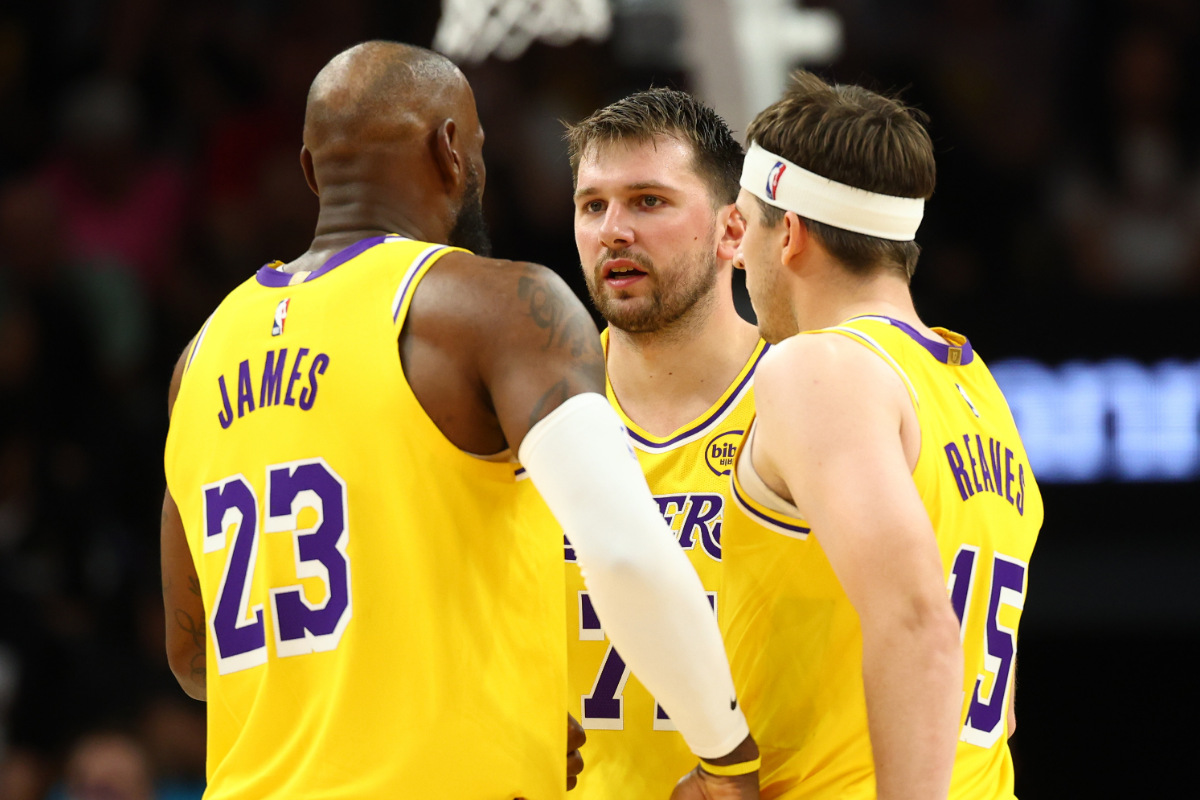
Tension had been building across the season. James had willingly subordinated his offensive role to accommodate Luka Doncic and Austin Reaves, a genuine sacrifice from a player still capable of carrying a team, and the sense that the organization was not adequately acknowledging that sacrifice had calcified by the time the postseason arrived.
Reiter was careful to apportion blame evenly: “I’ve covered LeBron a lot more than Luka. I can’t speak to the degree to which it’s Luka Doncic’s problem, or he’s the cause of this.” But the structural conclusion was firm: “LeBron wants to be the guy, and Luka wants to be the guy. And I just don’t think they fit together.”
The physics of what happens when LeBron James is unhappy in a locker room are, by this point in his career, well documented. Reiter put it plainly. “When LeBron is unhappy with people in his locker room, it is awkward. It is weird. It does not go well. He is the sun. The physics of any team he’s a part of bends to LeBron’s will, in a good way when he’s happy, and a bad way when he’s not happy.”
Even the small signals told their own story: Luka Doncic, in a February interview with Spectrum Sportsnet, laughed off the fact that he and LeBron still had not developed a personalized handshake, the kind of ritual LeBron has with virtually every teammate of significance he has ever played with.
“No, no, we don’t have yet,” Doncic said, brushing it aside. Those who know LeBron well know that the handshake is never just about the handshake.
“A Happier Place”: Why Reiter Believes Cleveland Is the Logical Destination
Reiter did not stop at the diagnosis. He moved directly to the prescription, and it pointed northeast.
“I would imagine, based on his love for Akron and that part of Ohio, that being in Cleveland with James Harden, who he’s close to, with Donovan Mitchell, I just think it would be a happier place for LeBron as a basketball player.”
The emotional case is real. LeBron’s Boys and Girls Club in Akron has been a central pillar of his public identity since before his NBA career began, and the familiarity and warmth he feels in Northeast Ohio have been something he has spoken about repeatedly throughout his career.
Reiter’s framing is that the Cleveland option is not just a basketball decision; it is a lifestyle and happiness decision, and for LeBron James, those two things have always been intertwined.
Betting markets currently list the Cavaliers as the second-most-likely destination for LeBron at +213, behind a Lakers return or retirement, and the financial architecture exists to make it work.
With James Harden’s player option for 2026-27 widely expected to be exercised, and Donovan Mitchell locked in as the franchise centerpiece, the Cavaliers can construct a roster around LeBron’s needs without requiring him to subsidize anyone else’s prominence, the exact opposite of the Los Angeles dynamic Reiter described.
When LeBron is happy, things go well,” Reiter concluded. “And when LeBron is not happy, things go very badly.”
The Lakers, apparently, have spent this entire season in the second category. Whether LeBron’s exit interview signals confirm or contradict that read will be the defining story of the NBA’s summer, and Reiter, for one, has already placed his bet.