



When Anthony Edwards came down awkwardly on his left knee contesting a layup vs the Denver Nuggets in Game 4, the initial fear in the Target Center was that the Timberwolves had just lost their franchise player for the postseason. The MRI confirmed a bone bruise and hyperextension with no structural damage, but Shams Charania reported he would miss multiple weeks, putting his entire second-round availability in genuine doubt. But eight days later, he was in the starting lineup against Victor Wembanyama and the San Antonio Spurs. Now, after Minnesota’s season ended in six games, Jon Krawczynski of The Athletic has revealed exactly what drove that rush back, and what it cost.
“Edwards made another leap in Year 6, becoming one of the best crunchtime scorers in the NBA and inspiring his teammates with the toughness he showed in coming back from a hyperextended knee in just eight days,” Krawczynski wrote. “He told teammates he really believed that if he could get back on the court after his injuries, the Wolves could win a title. He pushed his body to the edge to try to make it happen.”
The decision was not medical clearance, pushing a reluctant player toward the floor: it was a 24-year-old with a genuine belief that this team, healthy, was built to go all the way.
Anthony Edwards “pushed his body to the edge” to play through his injuries because he truly believed the Timberwolves could win a championship, per @JonKrawczynski
“He told teammates he really believed that if he could get back on the court after his injuries, the Wolves… pic.twitter.com/DFFicxoFMR
— NBA Base (@TheNBABase) May 16, 2026

Anthony Edwards returned but not fully recovered, as he managed pain in both knees throughout the series, a visible reality that even his teammates and coaches acknowledged openly as the series developed. He scored 24 points in the Game 6 finale, a performance that encapsulated everything Krawczynski described: the talent undeniable, the body compromised, the outcome still not enough.
“I wasn’t expecting to be going home this early,” Edwards said after the loss. “So I haven’t thought about what I’m going to add to my game.” It was the most honest sentence he could have offered, a man who bet everything on a championship run and came home empty-handed before he’d even begun processing what comes next.
The broader context Krawczynski provided made it clear that the individual sacrifice was only part of the story. The supporting cast around Edwards in the moments that mattered most in Game 6 produced a combined line that told the whole story: Jaden McDaniels went 4-for-13 for 13 points with one rebound. Julius Randle converted just one of eight shots for three points. Rudy Gobert was scoreless on 0-for-4 shooting with three rebounds. The man who pushed his body to the edge to give his team a chance was not let down by his own performance. He was let down by the infrastructure around him.
The Questions That Won’t Wait Until Next October
The reckoning was immediate and public. When asked what needs to happen for Minnesota to close the gap on the Spurs and Thunder in the West, Edwards gave an answer that was as revealing as it was brief. “I don’t know, man. I don’t think that’s a question for me.” Coach Chris Finch was blunter about the organizational imperative. “You either gotta be a problem or have a solution,” Finch said. “You have to be built in a way that troubles your opponent with something they don’t have or have something to counter what they do have.” It was a coaching staff framing the roster rebuild conversation in public, which means the front office heard it loud and clear.
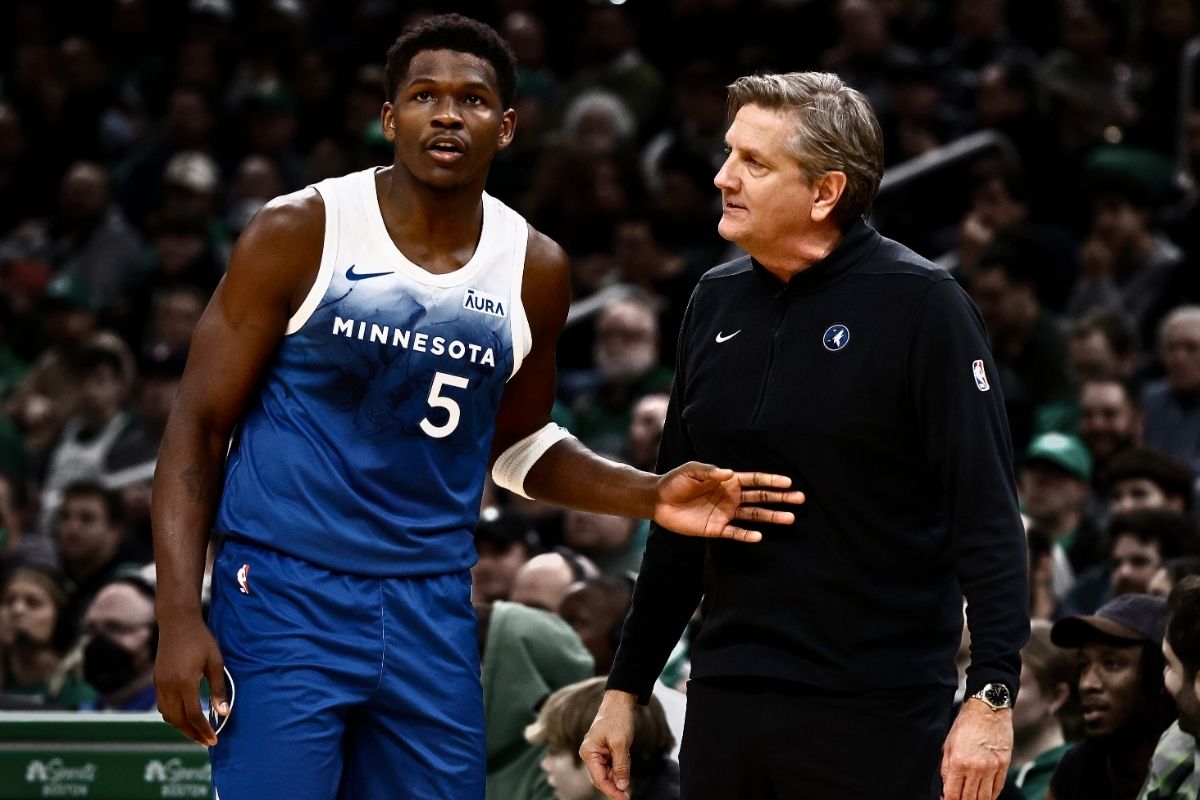
Krawczynski’s assessment of where the Wolves stand was equally direct: the goals have changed. Just winning a series or two is no longer enough for a team built around Edwards, and the reason he risked his knee to return in eight days is that he genuinely believed the ceiling in 2026 was a championship. With Donte DiVincenzo also suffering an Achilles injury in Game 4 against Denver, sidelining him for the remainder of the postseason, Minnesota was playing its semifinal series without two key contributors, leaving a supporting cast that was already a question mark even further exposed.
The Western Conference final spot went to San Antonio. The conversation about how Minnesota gets there next year starts now, built on the foundation of a 24-year-old who taped up a hyperextended knee and went back to work because he believed. The organization now owes him an answer to the question his coach just asked out loud.