

















Owen Farrell: man of 112 England caps and a million headlines, good and bad. Veteran of four British & Irish Lions tours and in his 18th season as a senior player. And now on a new path to the next stage of his career, as a coach, having taken a role looking after his club Saracens’ Premiership Cup team this year. Where will it take Farrell? Saracens, England, the Lions?
“It’s clear that bringing back Owen back to Saracens was not as a player, per se,” says Jez Denton, a co-presenter of Sarries’ supporters’ podcast, Fezcast. “It’s bringing back Owen into the club because he is going to be the man who will step into that coaching role at some point. And I’d put a tenner on Owen Farrell being England head coach, two or three World Cups down the line.”
Farrell himself has said little about his plans since his return last summer from an ill-starred year playing for Racing 92 in Paris.
His step forward in coaching came in Saracens’ Prem Cup matches in November and March, when it is customary for directors of rugby to give experience to assistants, and Farrell worked alongside lead coaches James Tirrell and Rob Webber.
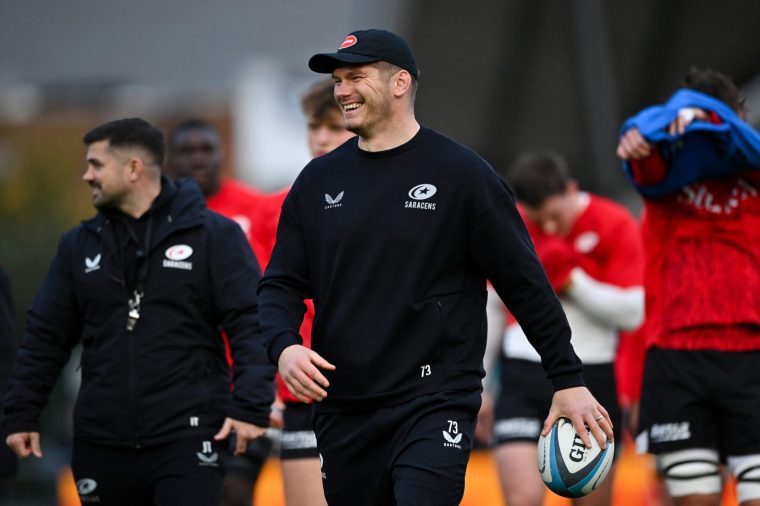
And while Mark McCall, the Saracens director of rugby, pays due deference to coaches including Tirrell, Webber and Duncan Taylor on the club’s pathway, he gives a significantly savvy chuckle to a question about Farrell sitting in the coaches’ box during spells of injury, even before he left for Racing. “There’s also having somebody who knows quite a lot about rugby,” McCall tells The i Paper. “That’s a good thing too.”
And that’s the nub of this story.
If the 34-year-old Farrell can learn the ropes of coaching – of communication and the other necessary skills – you can see top teams lining up for his services, because the rancour over his tackle technique in years gone by has always been secondary to glowing testimony from players and coaches on his galvanising effect.
McCall frames Farrell’s Prem Cup job within Saracens’ long-time commitment to preparing players for life after rugby.
“I see Owen showing an interest in and an appetite for coaching,” McCall tells The i Paper, “and we want to try to help him when he does pursue that career, that he’s already got some work under his belt.
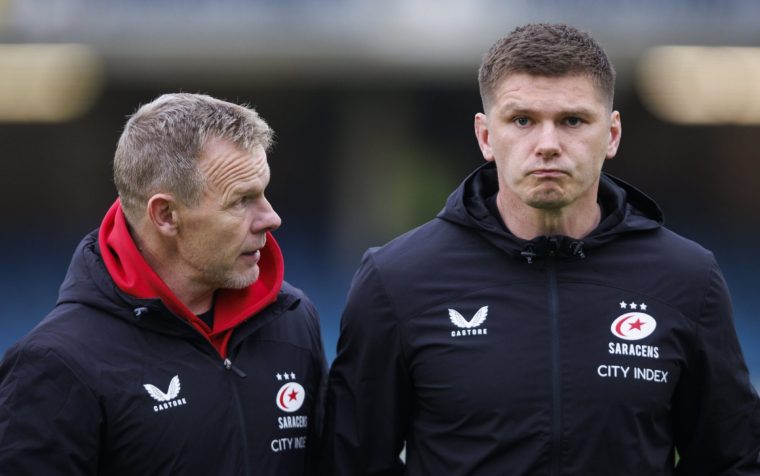
“He didn’t have a role to look after a particular aspect. He was in the coaches’ room for the whole time, hearing what’s discussed. He was part of having to review matches and talk to the team about what we could learn from matches, in unit meetings and team meetings.
“We just wanted to expose him to what happens in a coach’s week, on a game week. And I think that’s what he found enjoyable and very stimulating.”
McCall is leaving his own role this summer, to be succeeded by Sarries’ former boss Brendan Venter. For how long has not been made clear.
Farrell has another year on his playing contract, and McCall says he “could imagine” him adding to his experience at a Championship club and/or a school, as current England senior assistant Richard Wigglesworth once did with Saracens, Ealing and Harrow, while still playing.
Meanwhile, the success of Farrell’s father Andy with Ireland and the Lions has inevitably prompted talk of his candidacy for various posts, including England, who are currently reviewing the disappointing Six Nations results under Steve Borthwick.
Owen Farrell delivers the kick and Ben Earl finishes it off
Ben Earl even gave the fans a little something extra
pic.twitter.com/kecUh7Zwwl
— PREM Rugby (@premrugby) October 12, 2025

Could Andy and Owen team up, one day, for club or country?
Farrell junior’s Saracens return was made possible, McCall has previously said, by an injury to Alex Lozowski freeing space under the salary cap.
Denton says this season began well enough, with wins over Newcastle, Bristol and Sale Sharks featuring Farrell at inside centre and Fergus Burke at fly-half.
Then with Farrell having started seven of his subsequent 10 appearances at No 10, Saracens slipped to sixth in the Prem, unlikely to make the play-offs, and knocked out of Europe in the last 16.
But Denton speaks persuasively of players of pace like Burke, Olly Hartley, Noah Caluori, Tobias Elliott, Angus Hall and Jack Bracken, “learning from the master” of Farrell as the stable midfielder and off-field mentor, and accelerating this process in what remains of this season.
“Owen is one of the greatest players, if not the greatest player, to grace the Premiership,” says Denton, a former amateur player himself, and a Saracens supporter for 30 years. “What you get from him is 100 per cent commitment, 100 per cent determination. I’ve been down to training a couple of times and you see it. And it would be ridiculous not to use that.
“He is not the player he was 10 years ago; he’d be the first to admit he’s different. But he sets standards that he expects other players to achieve. We saw when he was brought into the British & Irish Lions [last summer] that standards immediately stepped up.
“In the Six Nations when George Ford suddenly had his big wobble, I would have loved to have seen Owen Farrell come into that, purely to stand outside Fin Smith and Marcus Smith, both of whom, at different stages of their career, need someone like Owen Farrell, giving them that extra two per cent, either as a player or a mentor or a coach in that organisation.
“Because, really, he’s always been a coach. We’ve seen it in this last period. The one player that Mark McCall goes to at half-time as they’re walking off the field is Owen Farrell.”