
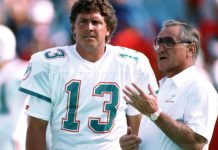















Dan Marino is one of the greatest quarterbacks to ever play in the NFL who never won a Super Bowl. And when you look at the timeline of the Miami Dolphins under Don Shula, it almost feels hard to explain. The Dolphins reached three straight Super Bowls in the ’70s and won two of them. Then, just a season before drafting Marino, they made another trip to the big game during the 1982 season.
But once Marino arrived in Miami, the Dolphins reached only one Super Bowl and never returned during his tenure. That naturally raises the question: How did one of the greatest quarterbacks the league has ever seen never become the defining quarterback of his era? Former NFL wide receiver and Hall of Famer Cris Carter believes Don Shula was part of the reason.
“Dan Marino was underrated. Dan Marino was doing exactly what Patrick Mahomes was doing in the 80s,” Carter said. “Where dudes were throwing for 2,000 yards, he was throwing for 4,000. I think Don Shula and the Dolphins mismanaged his career. They did not put things around him. Like, he goes to a Super Bowl and then never gets far in the playoffs after that. If Dan Marino is going to play 17 years for you and you’re only going to win a handful of playoff games? He has the most magical arm of anybody I’ve ever seen.”
View this post on Instagram
Following his rookie season, Marino exploded in 1984 by setting NFL records with 48 touchdown passes, a mark later surpassed by Peyton Manning in 2004, and 5,084 passing yards, which Drew Brees eventually broke in 2011, as he carried the Dolphins to the Super Bowl. At the time, many believed Miami was on the verge of building another dynasty.
But after the 38-16 loss to Joe Montana and the San Francisco 49ers in Super Bowl XIX, the Dolphins never made it back. Across his 17-year career, Marino crossed 5,000 passing yards once, 4,000 yards five times, and 3,000 yards seven times. The talent and arm strength were never the issue.
The problem was that the quarterback is still just one position. No matter how great the arm talent is, winning championships usually requires help from both the run game and the defense. And throughout most of Marino’s career, the Dolphins struggled badly in both areas.
One glaring issue during Dan Marino’s tenure was the lack of elite running backs. Back in the ’70s, Don Shula built the Dolphins’ offense around a dominant rushing attack led by Larry Csonka, who rushed for 1,117 yards and five touchdowns in 1972 and followed it with 1,003 yards and five touchdowns in 1973.
Alongside him were Mercury Morris, who posted 1,000 rushing yards and 12 touchdowns in 1972 before adding 954 yards and 10 touchdowns in 1973, and Jim Kiick, who contributed 521 rushing yards and five touchdowns in 1972 and 257 yards in 1973. That trio played a massive role in helping Miami win back-to-back Super Bowls in the 1972 and 1973 seasons.
During Marino’s years, though, the running game constantly lacked stability with players like Lorenzo Hampton, Andre Franklin, and Bernie Parmalee cycling through the backfield. To put that into perspective, Hampton lasted only five seasons in the NFL, while Franklin played just four. Parmalee had the longest run of the group, spending seven seasons with the Dolphins from 1992 to 1998. Across 104 games, Parmalee rushed for 1,959 yards and 15 touchdowns while also adding 1,306 receiving yards and three receiving touchdowns, but he was never a true RB1.
Meanwhile, Marino had just one 1,000-yard rusher during his entire Dolphins tenure when Karim Abdul-Jabbar rushed for 1,116 yards and 11 touchdowns in 1996 (Shula was no longer with Miami after the 1995 season).
Compare that to John Elway. Like Marino, Elway spent most of his career without a Super Bowl. But once the Denver Broncos landed Terrell Davis, everything changed. Davis rushed for 1,750 yards and 15 touchdowns in 1997, then followed it with 2,008 yards and 21 touchdowns in 1998 as Elway closed his career with back-to-back Super Bowl wins.
The run game, however, was not Miami’s only issue. The defense also failed Marino for long stretches of his career, especially under defensive coordinator Tom Olivadotti.
Failed draft picks and defensive decline hurt Dan Marino throughout his Miami years
During Marino’s 17 seasons, Miami finished inside the top 10 in points allowed only five times: 1983, 1984, 1990, 1995, and 1998.
Tom Olivadotti served as Miami’s defensive coordinator from 1987 through 1995. While the Dolphins improved from 26th to 16th in points allowed during his first season, they still ranked 26th in total yards allowed. The following year, Miami again ranked 26th in total defense. By his third season, the Dolphins sat 22nd in points allowed and 24th in yards allowed.
At the same time, Shula struggled badly with several key defensive draft picks. Players like John Bosa and Eric Kumerow failed to become long-term contributors after being selected in the first round in consecutive years.
Bosa, selected 16th overall in 1987, saw his career end after the 1989 season. Then in 1988, Miami used another first-round pick on Kumerow, who was already out of the league by 1991. In simple terms, Miami burned back-to-back first-round picks on defensive players who never developed into impact pieces.
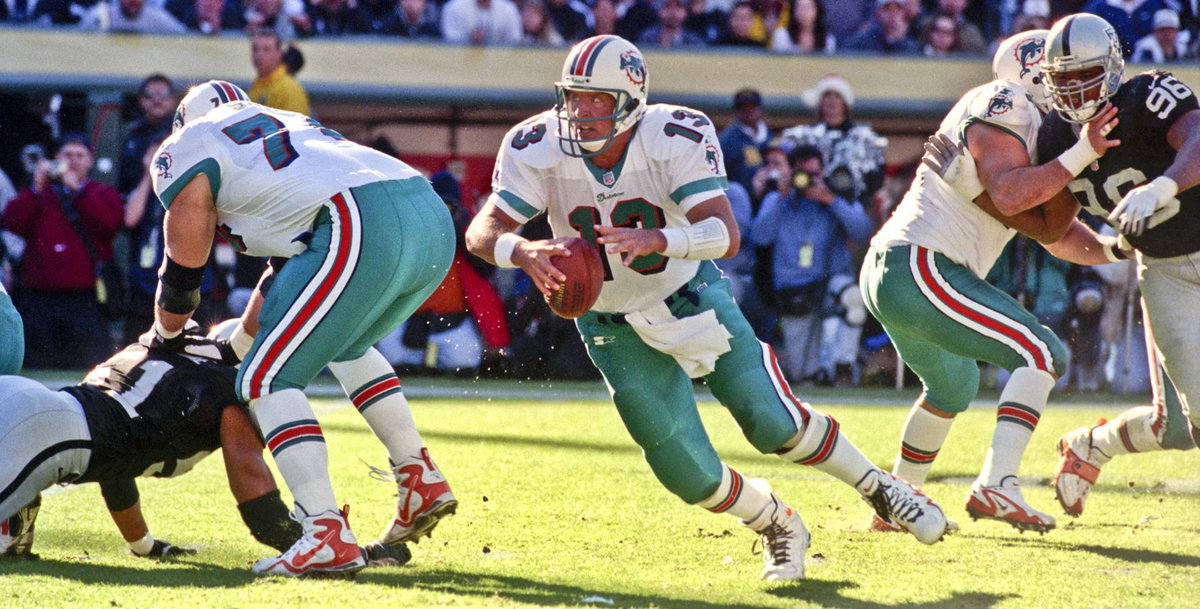
And the overall numbers reflect that. Across Marino’s 17 seasons, Miami’s defense ranked outside the top 20 in total yards allowed eight times. They also finished outside the top 20 in scoring defense five times, while hovering around the lower-middle tier several other seasons.
At the same time, Marino also carries part of the responsibility. Despite all the regular-season brilliance, the postseason success never fully matched it. He reached the playoffs 10 times but made only one Super Bowl appearance, while carrying an 8-10 postseason record. Under Don Shula alone, Marino played in seven postseason games and lost three of them to the Buffalo Bills only.
There were also long-running arguments that Marino preferred leaning heavily into the passing game rather than committing to a balanced rushing attack. That said, Marino will always remain one of the greatest regular-season quarterbacks the NFL has ever seen. But without the championships, he ultimately falls short of being remembered as the defining quarterback of his era.