

































Maria Sharapova and John McEnroe sat down for one of the more entertaining tennis debates in recent memory, and predictably, they didn’t agree. The two legends were asked who their Mount Rushmore of women’s tennis was, and the conversation that ensued was candid and at times hilarious, covering everything from Serena Williams’ serve to Martina Navratilova’s courage in coming out publicly decades before the sport was ready for it.
Both Sharapova and McEnroe led with the same name, and it was never going to be anyone other than Serena Williams.
“I had a front row seat to Serena’s greatness, right? Starting at the very beginning, where she kicked my ass, and finishing at the very end, where she kicked my ass many more times,” Sharapova said, drawing a laugh from McEnroe.
The figures support what Sharapova was saying. They are 20–2 against one another, with Williams leading the series 8–1 at the majors and 3–1 in Grand Slam finals. This wasn’t always the case. Sharapova beat her twice in their first three encounters, and in the 2004 Wimbledon final, the 17-year-old took down the reigning champion. However, Williams would go on to win all 19 of their next encounters, dropping just three sets in those contests. Their last encounter, at the 2019 US Open, ended 6-1, 6-1.
Sharapova’s evaluation of Serena didn’t just cover the 23 Grand Slams and the records. She focused on a specific aspect, the serve.
“Her accuracy on the serve is the greatest. She has the greatest serve of anyone. Her toss is in the same place every single time. Usually, with players on break point, they’re a little nervous. There will be hints of where they’re going to serve. With Serena, it’s robotic. Same place every time, and it’s not even about power. It is so accurately placed on the biggest of points. And you feel it,” Sharapova said.
McEnroe did not push back. “She’s one of the greatest competitors, period. If you had a Mount Rushmore of greatest athletes, she might be on that list, male or female, in the last 100 years.”
John McEnroe and @MariaSharapova sit down with Ari and Ben to debate who deserves a spot on the Mount Rushmore of greatest female tennis players ever.
Dominance defined. Matches remembered. But only 4 names can stand above the rest.
HOW’D WE DO?
Presented by @Polymarket pic.twitter.com/ZvRWcUISuD
— RUSHMOREonX (@RUSHMOREonX) May 12, 2026
From there, the two went their separate ways.
Sharapova’s second pick was Monica Seles, and the reasoning was rooted in a memory that clearly never left her. “I was very young. I had a wild card. I win my first round. I draw Monica. I lose. I come off the court and I think to myself, I felt like I just played the best match in my life. There was nothing I could do better. And she smoked me. I didn’t even cry, because I was like, there’s just nothing. The level was so far.”
The detail the five-time Grand Slam champion came back to was not the result, but the sense of seeing greatness from the other side of the net. Seles has won eight Grand Slams, but before turning 19, she was stabbed on court, and it still sounds like a genuine disbelief in Sharapova’s voice. “She was the youngest US Open champion at 16. You could just see that determination. That is a quality.”
Both agreed on Steffi Graf. Sharapova framed it around professionalism and focus “She was all tennis. No distractions. When you get to the top and you look at greats and how they handled success, she was an example.”
McEnroe’s take was more direct: “I consider her possibly as good as, or better athletically, than anyone I have ever seen, man or woman, in the sport of tennis.” He added a personal detail that landed with weight: “We practiced together when we were both sort of at our best, and I was like, she was just unbelievable. The focus was there, the athleticism, the intensity.”
McEnroe and Graf are two of the most successful Open Era singles careers, with Graf holding 22 Grand Slams and being the first player, male or female, to win all four majors and an Olympic gold medal in the same year. Even a competitor such as McEnroe, who trained alongside her, had no words to describe her athletic ability as much as any statistic.
The Steffi discussion also yielded the hottest part of the segment, when McEnroe noted that her backhand slice, which she used on almost 90% of backhands, wouldn’t work on the modern tour. “I don’t think they could handle the pace. You can’t hit a slice off a flat hard shot,” he said. Sharapova’s response was blunt: “Speak for yourself.”
With two names in common till now, with Sharapova choosing Seles as the odd one out, McEnroe had his own reasons to choose a different list with a solid reasoning.
Where Sharapova and McEnroe Diverged
The actual split occurred with the last two picks. Maria Sharapova chose Chris Evert, not for the titles but for what Evert stood for outside the court. “She was class, but she brought an element to the game that transcended just being a champion. She was one of the first to do things off the court that I could look back to. She was on my mood board when I was designing looks with Nike.”
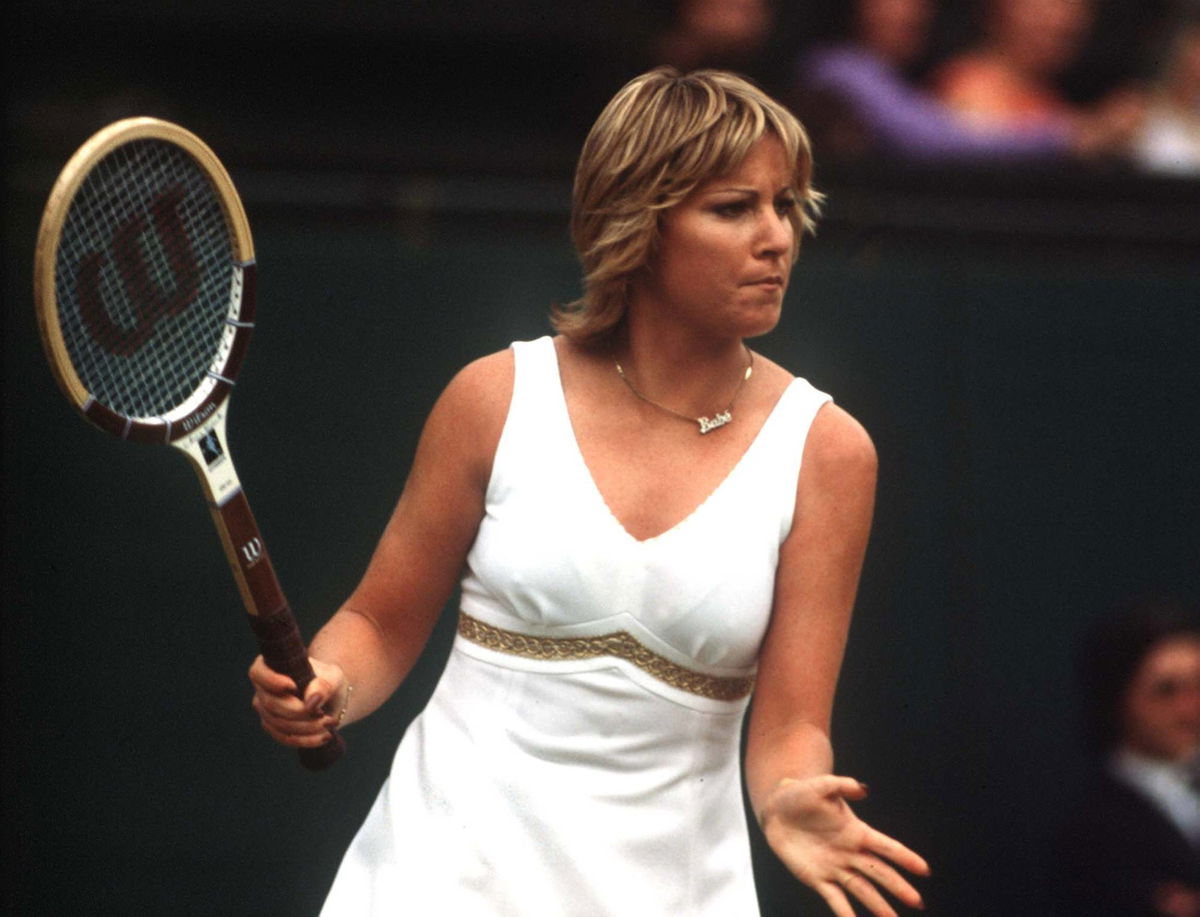
Chris Evert (USA) sports a necklace with Babe on it. Wimbledon All England Tennis Championships, 1977. PUBLICATIONxINxGERxSUIxAUTxHUNxPOLxUSAxONLY; Tennis Damen vdia xmk 1977 quer Wimb77
Image number 07826569 date 01 07 1977 Copyright imago Color Sports Chris Evert USA Sports A necklace with Babe ON It Wimbledon All England Tennis Championships 1977 PUBLICATIONxINxGERxSUIxAUTxHUNxPOLxUSAxONLY Tennis women Vdia xmk 1977 horizontal Wimb77
Evert won 18 Grand Slam titles over the course of her career and was ranked world No. 1 seven times. Sharapova was talking about the template she established for women to be treated with seriousness as public figures, rather than just athletes. Though McEnroe admitted his father had a fondness for him despite his on-court demeanor, he said it was “a tremendous selection,” but he wasn’t pursuing that way himself.
McEnroe’s third pick was Billie Jean King. “Single-handedly, out of the last 100 years, she’s done more for women’s sports than any person on the planet. The Battle of the Sexes. She was part of the reason Title IX happened. Until this day, she goes to every single big women’s event there is: volleyball, soccer, anything. She goes to the opening of an envelope, if it has to do with women,” he said.
In 1973, King beat Bobby Riggs, and McEnroe saw the match at a house party when he was 14. The broader context of that night is worth sitting with. Riggs, who described himself as a “hustler” and “man chauvinist,” said the women’s game was so inferior that the best female players couldn’t beat him. King’s win was watched by 50 million people in the United States and an estimated 90 million worldwide, at the Houston Astrodome. After the match, King said she thought it would set women back fifty years if she lost. King’s win, along with the passage of Title IX, is frequently cited as both sparking a surge in women’s sports participation and inspiring women to call for equal pay in every sector of the workforce.
His fourth was Martina Navratilova, and he made the case with characteristic directness. “Not only because she’s a fellow lefty. She defected at 16, 18 years old, left her family, and then on top of trying to be the best player in the world, she came out and said she was gay. She lost all her sponsorships. People looked at her like, can you imagine coming out in 1979 or 1980? And despite all of that energy she had to deal with, she continued to win. That to me is extremely difficult to do.”
Navratilova had a total of 18 Grand Slam singles titles, nine of which were won at Wimbledon, and 59 combined Grand Slam singles, doubles, and mixed doubles. The victories were not earned because of the challenges, but rather, almost because of all the obstacles the sport and the time provided her.
Four legends, two Mount Rushmores, one agreement on two of the four names. Like all debates between McEnroe and Sharapova, it resulted in a lot of insight, but little consensus, which is the point of the debate.