










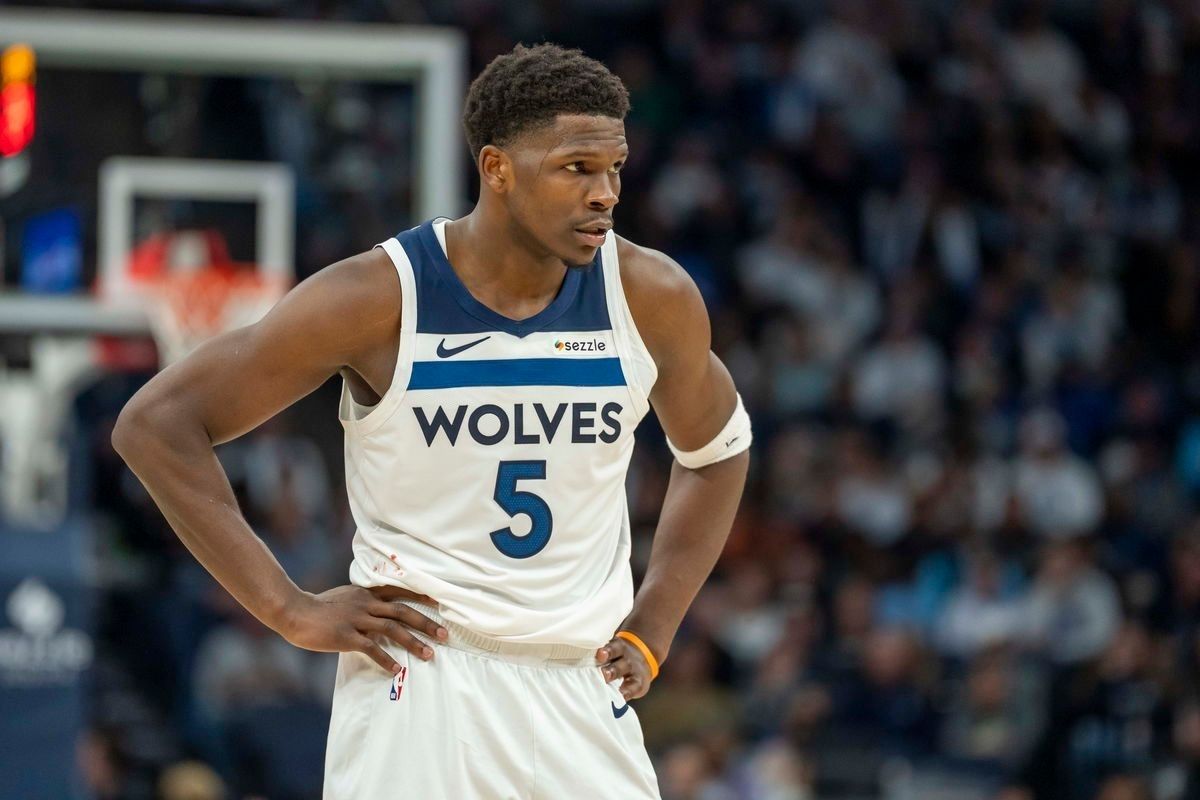
For Anthony Edwards, the frustration over the NBA’s 65-game rule was never about awards. It was about not being out there. Before the season ended, his business manager made that crystal clear. “He was mad he didn’t get to 65, but not because he missed out on awards; he was mad because it meant he didn’t get to play in all 82, which is what he always tries to do for his teammates and fans,” Justin Holland said. “You know the only thing he wants is a ring!”
That context matters because the player who became one of the most high-profile casualties of the NBA’s most debated rule is also the one who least fits the profile it was designed to target. Now, NBA commissioner Adam Silver has finally addressed the Anthony Edwards controversy, expressing sympathy while still standing firm on the policy.
“I feel bad for Anthony Edwards,” Silver said. “He’s a great guy. But I still think the rule is working.” The commissioner then laid out the statistical foundation for why the policy, however uncomfortable in individual cases, exists: “Remember, even when we came together with the union and passed this rule, one-third of all NBA players the season before we put it in place did not play 65 games, which is crazy. And games missed by star players is down 31% this season. So it’s working.”
The numbers only made Edwards’ case harder to ignore. He played 79 games in each of the previous two seasons and built a reputation as one of the league’s most durable stars. This year, it took legitimate injuries, from a hamstring strain to knee inflammation and illness, to keep him at 61 games.
Even then, he averaged 28.8 points, 5.0 rebounds, and 3.7 assists on 48.9 percent shooting, a career-best season that would have comfortably earned All-NBA consideration under any previous system.
Instead, an independent arbitrator denied his appeal.
The inconsistency became impossible to ignore when the league and NBPA jointly granted extraordinary circumstances exemptions to Luka Doncic and Cade Cunningham. Doncic played 64 games after missing time for the birth of his daughter, while Cunningham appeared in 63 after suffering a collapsed lung.
Edwards, who played 61 games and dealt only with legitimate injuries, had his case advanced to an independent arbitrator, who ultimately denied it, creating three different outcomes under the same rule.
A Rule Built on Principle, Not Precision
Silver’s explanation on WFAN acknowledged the logic behind the system without apologizing for the outcome. The rule, he noted, operates within a zero-sum framework.
“From the union standpoint, it’s zero-sum. In our collective bargaining agreement, if we pay out 50% of the revenue, we pay out 50% of the revenue,” Silver said. “To the extent one player doesn’t get the money, another player does. So the union is always on both sides of these things.”
That financial dimension underlined why the exemptions granted to Doncic and Cunningham carry real consequences, with an All-NBA selection now having a direct bearing on a player’s ability to earn a supermax contract extension.
Timberwolves head coach Chris Finch was pointed in his response to the outcome, saying: “I’m not sure why we have a rule if we have an appeals process that is overturned in two-thirds of the cases held before it. It feels more like a suggestion than a rule. It just feels a little unfortunate that he was the only one left out.”
The CBA’s extraordinary circumstances provision does not define what qualifies as “extraordinary,” leaving the decision entirely to the arbitrator’s discretion. That ambiguity is exactly what Finch pushed back on.
His issue was not with Doncic or Cunningham, whose situations he acknowledged were legitimate. It was with a process that produced three different outcomes without clearly explaining why Edwards’ case fell short.
With the decisions finalized, the NBA sent award ballots to media voters on Thursday, with results expected in the coming weeks as the playoffs get underway. Edwards, meanwhile, is healthy and ready for Minnesota’s first-round series against the Denver Nuggets, still the centerpiece of a team built around him despite being shut out of the awards conversation.
Silver’s “I feel bad” was as close as the league has come to acknowledging the human side of the rule, even if no changes appear imminent. As he put it, the policy has “changed the attitude about guys.” Edwards, a player who never needed his attitude questioned, is the one left paying the price.