



















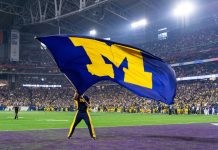













The debate over merit stickers at Michigan is a classic clash between “tradition” and “swag.” While the iconic winged helmet dates back to 1938 and is seen by many as a masterpiece that shouldn’t be altered, Jim Harbaugh’s decision to bring back helmet stickers in 2015 has kept this fanbase divided ever since. Interestingly, the Wolverines’ 1997 Heisman Trophy winner, Charles Woodson, supports a tradition followed by the Buckeyes.
“When I went to Michigan, I dreamed of getting those stickers and placing them on my helmet,” commented Woodson on IG this week following a Michigan Football post regarding the helmet debate. “We got em but instead of placing them on our helmets, they were placed on a chart inside Schembechler.  Bring on the stickers, Goblue.”
While Woodson famously wore the “clean” winged helmet, he has surprised many by expressing a preference for Ohio State’s tradition of rewarding players. The helmet stickers at Ohio State include a small, circular white decal with a green Buckeye leaf and red bud in the center.
It’s simple to earn them. Make big plays. Winning means the entire team gets a sticker. More importantly, the helmets of the key players are virtually covered by the time the Buckeyes play the Wolverines at the end of the regular season. For reference, have a look at the helmet of Jeremiah Smith when he caught a touchdown pass in the second quarter of The Game last season. You can count at least 30-40 stickers.
Woodson’s preference is also interesting given how his Heisman story is connected to the Buckeyes. In 1997, He became the only primarily defensive player to win the Heisman Trophy. His “Heisman moment” featured a 78-yard punt return for a TD against Ohio State, followed by an interception that sealed the victory. Then, he was a rare three-way threat, dominating as a CB, returning punts, and frequently lining up at WR to provide explosive plays for the 1997 National Championship team.
However, Woodson arrived in Michigan in 1995, the exact year Coach Lloyd Carr scrapped the sticker tradition to emphasize “team over individual.” Consequently, his iconic #2 was always paired with a pristine, sticker-free helmet.
View this post on Instagram
But unlike rival OSU, whose uniform buckeye leaves denote performance within a single season, Michigan’s system is designed to narrate a player’s entire career. Stickers roll over each year, meaning a senior’s helmet serves as a visual “receipt” of their time in Ann Arbor. Rather than one repeating icon, the Wolverines use specific decals for different achievements.
Wolverine heads feature a number representing the program’s all-time win total at the time of the victory, while for hometown pride, every player gets a sticker with their area code. Unique designs commemorate All-American status.
The history of Michigan helmet stickers
In 1969, Bo Schembechler actually brought the sticker tradition from Miami (Ohio) to Michigan. He brought the reward system with him to instill personal and team pride, and it was simple: hand-cut maize-colored footballs. In 1985, the stickers returned with slight modifications and were a staple until the end of the Gary Moeller era.
In 1995, coach Lloyd Carr, who wanted to shift the focus from individual glory to team unity, famously scrapped the tradition. Then, Jim Harbaugh, who wore a sticker-covered helmet as a Michigan QB in the ’80s, reinstated them to reward player milestones. However, he drastically changed the philosophy in 2021. Unlike the old way, where stickers were reset each season, they accumulated over a player’s entire career, turning the helmet into a “permanent receipt” of their time at Michigan.
While some fans find the cluttered look a distraction from the historic wings, the current system is firmly entrenched as a way for players to wear their personal and program history on their sleeve, or rather, their head.