

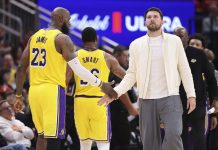



The Los Angeles Lakers scored just 90 points in Game 1 and spent almost the entire night chasing the Oklahoma City Thunder. Naturally, the conversation immediately shifted toward one question: when is Luka Doncic coming back?
The problem is that this series may have already shown why rushing Doncic back would be a mistake.
Even if Doncic returns sometime during this matchup, there is no guarantee he resembles the player he was before suffering a Grade 2 hamstring strain on April 2. More importantly, there is very little evidence that even a healthy version of him suddenly flips a matchup the Lakers have looked completely overmatched in all season.
Why The Lakers Shouldn’t Rush Doncic Back
After only scoring 90 points in Game 1 and posting an abysmal 95.7 offensive rating, LeBron James pointed to Doncic’s absence as the primary reason their offense was faltering.
“We have a guy that averaged 37 a game (not in the lineup),” James said, via Lakers Nation on X. “There’s the issues right there. We’re playing against the No. 1 defensive team in the NBA, as far as the ratings and everything. And when you play against great defenses, you have to have guys that can attract multiple defenders on the floor at all times.”
None of this is a criticism of Doncic himself. By all accounts, he has pushed aggressively to return as quickly as possible. However, LeBron’s comments overlook two major realities about both this injury and this matchup.
First, expecting Doncic to immediately return after more than a month away and still look like the same explosive offensive engine is unrealistic. Hamstring injuries are notoriously dangerous for players who rely on deceleration, balance, and change of pace as heavily as Doncic does. The Lakers are already watching a smaller version of that reality play out with Austin Reaves, who has looked completely out of rhythm since returning from his oblique injury.
Second, the Thunder simply appear to be a terrible matchup for this roster, regardless of whether Doncic plays. Oklahoma City swept the Lakers during the regular season by an average margin of 29.3 points per game. In the 59 minutes Doncic played against OKC this year, Los Angeles was outscored by 56 total points. That is not a small-sample warning sign. That is structural domination.
Even before Doncic got hurt, the Lakers never fully solved the balance between their three primary creators. The offense often looked cleaner when Doncic ran units by himself, while lineups featuring all three stars struggled to consistently generate elite two-way results. Defensively, adding another below-average perimeter defender against a Thunder team built around relentless downhill pressure only complicated the matchup further.
The Lakers’ Best Chance Might Be Leaning Into This Identity
This is not an argument that the Lakers are somehow better without Doncic. They clearly are not. However, against a historically deep and athletic Thunder team, lineup cohesion matters almost as much as raw talent. The Lakers never found a dominant five-man unit featuring their three stars all season, and history shows championship-caliber teams almost always establish at least one high-minute lineup that consistently destroys opponents during the regular season. Los Angeles never truly reached that point.
That is why forcing Doncic back into this series feels unnecessarily risky. If the Lakers fall behind quickly, they are exposing a franchise cornerstone to potential re-aggravation in a series they probably were not winning anyway. Meanwhile, if the Lakers somehow turn this into a competitive defensive series, throwing a rusty ball-dominant star back into the middle of it creates another adjustment problem entirely. Neither outcome is ideal.
Instead, the Lakers should fully commit to the defensive identity they are building without him. Losing Doncic has unquestionably damaged their offense, but it has also unlocked more aggressive defensive coverages that require constant rotation, switching, and perimeter activity. Against Oklahoma City’s speed and spacing, that matters. In Game 1, the Lakers held Oklahoma City to a 116.1 offensive rating, more than 11 points below the Thunder’s first-round average despite OKC shooting 43.3 percent from three-point range. Head coach JJ Redick has his mad scientist cap on (again), and his team believes that the results of his strategy will only get better with time.
Every time the Lakers Trapped SGA last night… pic.twitter.com/bDwmXKudFs
— Mike Jagacki (@Mike_Jagacki) May 6, 2026
“Yea we had a game plan and a few times we didn’t do exactly what we was supposed to do within the game plan,” Marcus Smart said after the loss. “And we got a little outside of ourselves of the game plan and they made us pay for it…We gotta stay with it. But I’m very positive in the way that the game plan is.”
Austin Reaves Needs To Be Better
It would also do wonders for the Lakers if their healthiest offensive creator, Reaves, could rediscover the level he played at earlier this season while Doncic was sidelined. Reaves was historic in Game 1, but, unfortunately, it was in the worst way possible.
Austin Reaves’ 18.8 FG% in Game 1 was the lowest by any Laker in a playoff game over the last 35 years (min. 15 FGA)
pic.twitter.com/1o97wPL1tq
— ESPN Insights (@ESPNInsights) May 6, 2026
As to be expected, Reaves has been under a great deal of scrutiny for his play since his return (he’s averaging 15 PPG on 42.4% true shooting). But if he is the player he wants to be paid like this Summer, he should be that guy who “can attract multiple defenders” that James was pining for.
If Reaves can return to his usual scoring efficiency and the Lakers can eke out similar production from their two-star setup, it gives them three other spots on the floor (instead of two) to allocate toward the glue guys who give you the kind of lineup cohesion you need to duel with the Thunder.
Regardless of whether Doncic feels ready, the Lakers need to think beyond this series. Hamstring injuries rarely care about playoff urgency, and there is no guarantee the version returning to the floor would resemble the borderline-MVP force the Lakers traded for.
More importantly, Oklahoma City has looked like the superior team in this matchup with or without him.
At some point, Los Angeles has to decide whether chasing a slim comeback opportunity is worth risking the long-term health of the player expected to define the franchise after LeBron James. Right now, the smarter gamble may simply be living with the result of this series and protecting the bigger picture.