




































In eleven turbulent years, Aryna Sabalenka has lived every emotion on court; clashing with officials, venting at coaches, and shattering rackets in raw frustration, yet rising to four Grand Slam titles and World No. 1. At twenty-seven, she stands as the most electrifying force in tennis today. And when she speaks candidly, her words hit as hard as her game; unfiltered, fearless, and deeply real.
Aryna Sabalenka reveals the secret behind smashing a racket
Aryna Sabalenka has never pretended to be anything but raw, and that honesty surfaced again in an Esquire conversation with editor-in-chief Michael Sebastian. When asked the oddly simple yet revealing question, “What’s the secret to smashing a racket?”, she answered without hesitation.
“You hit it as hard as possible,” she said, distilling years of pressure into one blunt line. It wasn’t just the technique she described, but release, the kind that only elite athletes understand when the stakes suffocate.
“Let all of that tension and emotion go out through the racket. Then let it go when the racket is broken,” she added, framing the act less as destruction and more as an emotional exhale. Yet even in that admission, there was awareness. “I’m so sorry to Wilson. In that particular moment, they probably don’t really like me.”
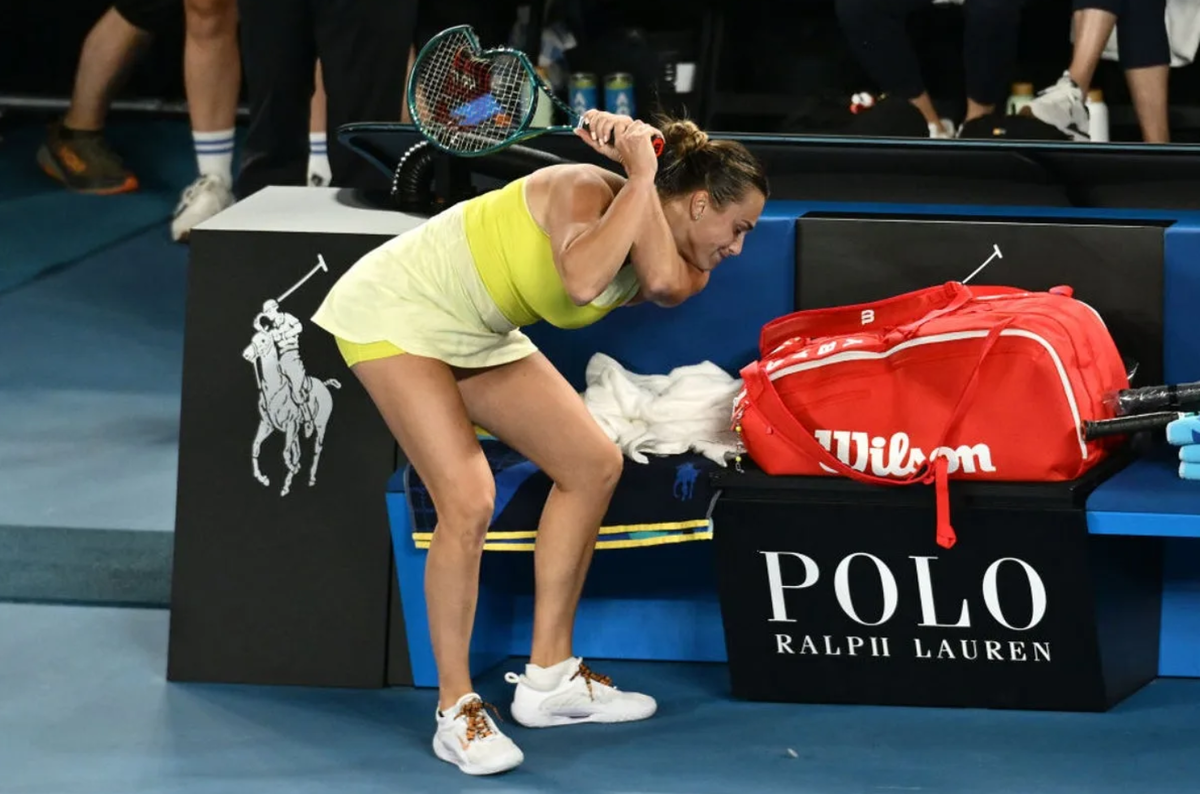
The sport, of course, has seen this before. Anger has always had a place in tennis, simmering beneath the silence, occasionally spilling over in splinters of graphite and regret.
For Sabalenka, those moments are part of the narrative. Cameras caught her in 2025, just after losing the Australian Open final to Madison Keys, unleashing her frustration on a racket moments after the handshake.
It was not an isolated image. At the 2023 US Open, she was again seen smashing her racquet after falling in the final to Coco Gauff, the weight of expectation collapsing in real time.
But the story does not belong to Sabalenka alone. The modern game, across both tours, is littered with these flashes of vulnerability disguised as rage.
Gauff herself endured a different kind of unraveling at the Australian Open, where a despondent performance, five double faults, 26 unforced errors, and just three winners in a 6-1 6-2 loss lasting 59 minutes, ended not with a smashed racket on court, but with a quieter breakdown captured behind the scenes and broadcast for the world to dissect.
On the ATP side, Daniil Medvedev offered a more violent punctuation, fined $7,000 after smashing his racket seven times during a brutal 6-0, 6-0 defeat to Matteo Berrettini at the Monte-Carlo Masters.
So perhaps the answer is not really a secret at all. It is impulse, pressure, and the unbearable demand of perfection colliding in a single, fleeting moment, one that Sabalenka, more than most, is willing to own.
Aryna Sabalenka reveals how she balances on-court aggression with off-court calmness
Aryna Sabalenka has never hidden the truth that success comes at a cost, and sometimes that cost spills out in raw, unfiltered emotion on court. The fire that defines champions is not always neat or controlled, and for a player like her, that fierceness is not optional; it is essential.
For the current World No. 1, the real craft lies in balance. She walks a fine line between intensity and composure, between the storm she unleashes during matches and the calm she carries away from them.
“Until the end of my life, I’ll have to do something where I’m that aggressive—maybe boxing—because I feel like I’m balancing these two personalities really well.” It is not a joke as much as it is a confession.
“On the court, I’m quite aggressive, quite emotional, which I need to be to pull out my best tennis. Off the court, I’m a completely different person.” That duality is not a contradiction; it is her design.
And if one moment captures that complexity, it is the 2025 French Open final. Sabalenka had the match in her grasp, taking the first set before slipping away against Coco Gauff under difficult, swirling conditions.
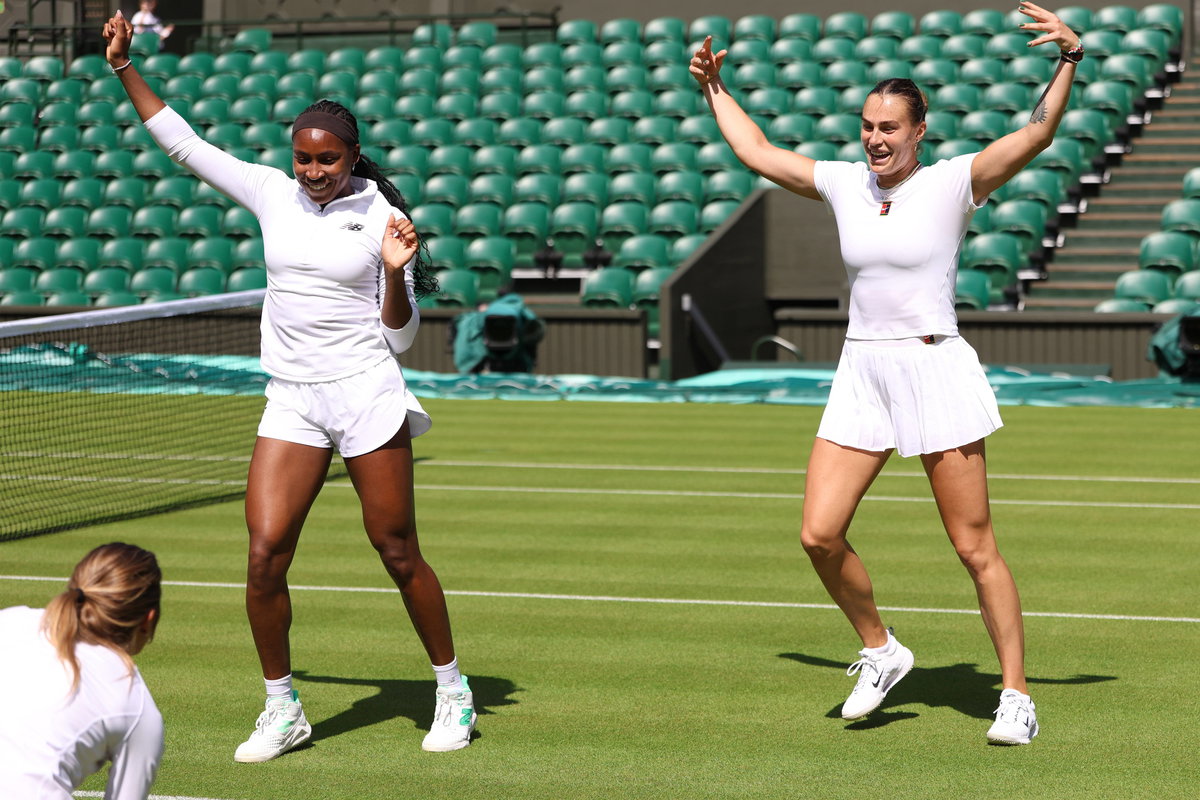
What followed was not just defeat, but honesty delivered a little too sharply. “I was making unforced errors; I have to check the stats. I think she won the match not because she played amazingly, but because I made all those easy ball errors.”
The reaction was immediate, and criticism came just as quickly. It was the kind of statement that exposes the thin line between candor and carelessness.
But the story did not end there. Away from the noise of the press room, Sabalenka responded differently: with a statement and a written apology to Gauff that quietly repaired what the moment had strained.
“I didn’t really want to offend her. I was just completely upset with myself, and emotions got over me. I just completely lost it,” she later admitted, offering something more revealing than the initial outburst, perspective.
And that is where Sabalenka remains most fascinating. On court, she can make opponents feel overwhelmed, even suffocated by her power and presence; off it, she disarms with warmth, humor, and an ease that feels almost contradictory.
In that contrast lies her truth. Not a player trying to choose between aggression and calm, but one who has learned, sometimes the hard way, how to carry both, and keep moving forward anyway.
Aryna Sabalenka reflects on how she overcame her serving struggles in 2022
Aryna Sabalenka’s rise to the top has never been a straight line, and 2022 remains one of the most difficult chapters of her career. Long before serving struggles became a wider talking point in the WTA, she was already battling a crisis that threatened to break her game.
Her serve, once a weapon, had turned into a liability. It was not just inconsistency; it was something deeper, something that began to chip away at her confidence point by point.
The numbers told a brutal story. Sabalenka ended the 2022 season with 428 double faults, the highest on tour, after already leading that unwanted list in 2021 with 338.
For any player competing at the highest level, those figures are more than statistics. They become a mental burden, a constant reminder of something going wrong at the worst possible time.
“It is a nightmare!” she admitted when asked about that phase in the conversation with Sebastian.
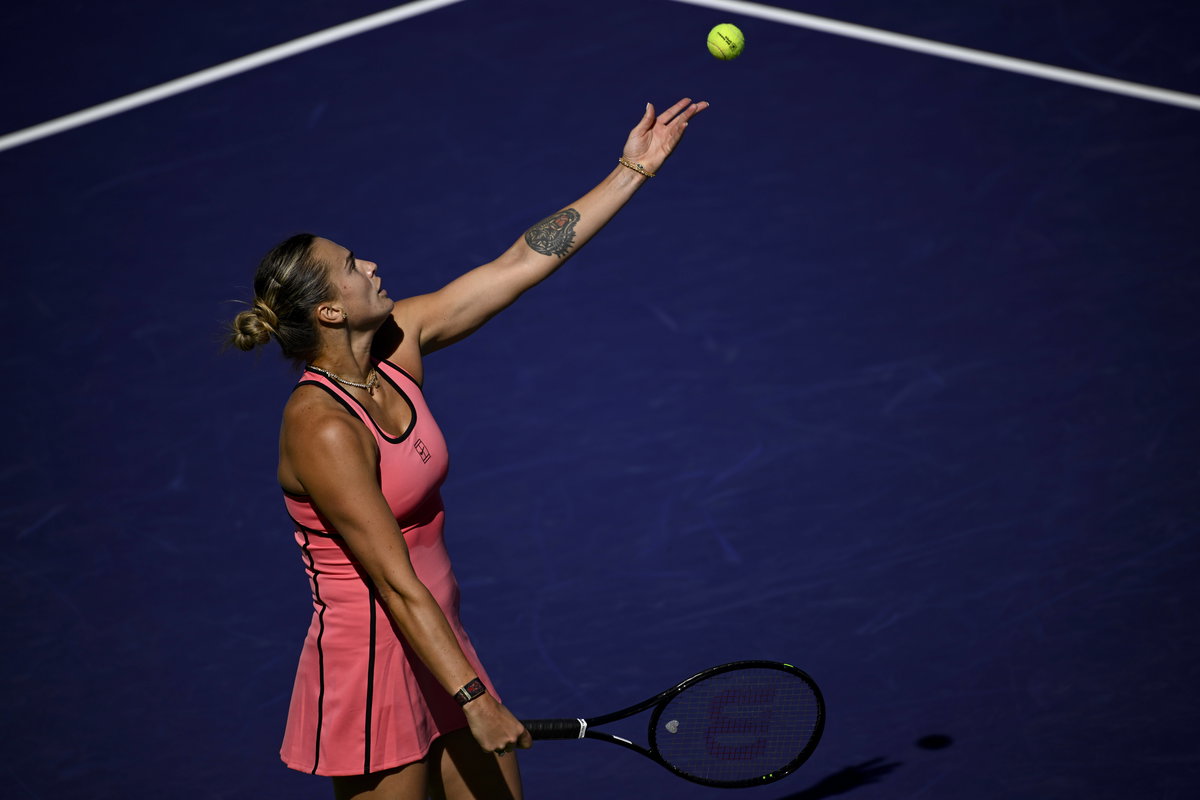
“I would never wish it to my enemy. It was tough because imagine you’re doing something for your whole life, and you’re really trying to be great, and you love the sport, and then at some point, just like that, you cannot serve.”
The struggle was not just technical. It crept into her mindset, making every match a test of endurance rather than skill.
“And then you struggle, you struggle, and you get to the point of just giving up. Mentally, that’s tough. That was a tough period, but it made me so strong, like never before.”
The turning point came when she decided to rebuild rather than retreat. She brought in biomechanical coach Gavin MacMillan, a move that would quietly redefine her career.
MacMillan addressed the root of her serving yips in 2022, and the impact was immediate. Sabalenka reached the semifinals of the US Open and carried that momentum into the following season, where she won the Australian Open.
His work went beyond the serve. He refined her entire ground game, identifying that she was rushing her forehand and preventing herself from generating full power and control.
By teaching her patience and proper rotation, he unlocked a more complete and dangerous version of her game. That improved forehand has since made her a consistent threat at the very top of the rankings.
Sabalenka now credits that biomechanical approach for restoring her confidence under pressure. The fear that once defined her serve has been replaced with belief.
“Nowadays, I’m confident that even if my serve is not going well, I can still fight and still try to win the match without my serve. That was tough, but at the same time, like a very good moment and a very good lesson for me.”
As the current World No. 1, she approaches the clay season from a position of strength. While many top players are competing at the Stuttgart Open, Sabalenka has chosen to sit it out and manage her schedule.
Even if Elena Rybakina, currently ranked No. 2, goes on to win the tournament, it would not be enough to take the top ranking away from her.
Her focus now shifts forward. With the clay-court swing ahead, she is preparing to build momentum toward the French Open, carrying with her the lessons of a struggle that once nearly ended everything but ultimately reshaped her into something stronger.