



























Last Saturday, I went to Wigan Athletic for a match experience with a difference. Matt Harrison is a Wigan supporter who, at the age of 32, was diagnosed with Stargardt disease, a macular dystrophy that starts with blurred vision and blind spots.
It progressed to the point that Matt’s sight loss became extreme. He jokes that the last Wigan goal he saw was Ben Watson’s winner in the FA Cup final and the honesty catches me off guard: “Nice to go out with a bang, eh.”
I wanted to shadow Matt for the day to better understand the experience of being registered blind at football matches, the tools that are designed to help him, and the ways in which football can – and surely must – improve.
These are the things that I learned from one of the most fascinating days I have spent in a football stadium.
I am in awe of Matt’s dedication
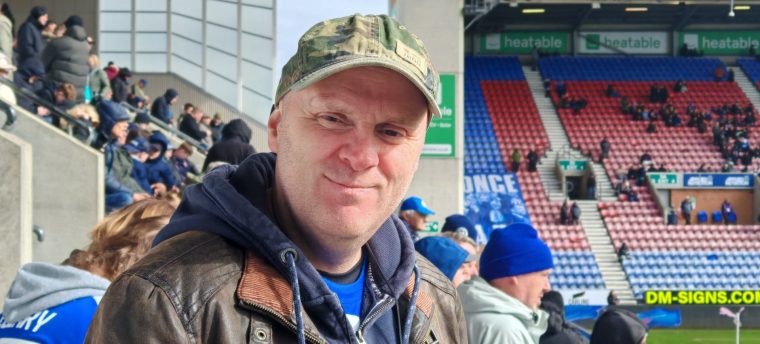
After we meet by the statue of Dave Whelan, Matt explains that this is a double-header weekend. He, his wife, two children and mum are attending today’s home match, staying over, and then going to the women’s game on Sunday. He lives in Nottingham and the family travel up and down the country for these matches.
Football, Matt says, was a large part of his everything. He met friends, found a wider family and bonded with strangers. When a scary diagnosis came, he was determined not to let his world shrink even further.
But it’s hard. Matt remembers what football looked like and that must be difficult to process. Football stadiums, particularly those that are unfamiliar and ancient, are not designed for those without sight to explore easily. So when Matt talks of double headers and ticking off new grounds, I am in awe and I hope that doesn’t sound patronising. Football supporters are great and he is better than most.
Put yourself in someone else’s reality
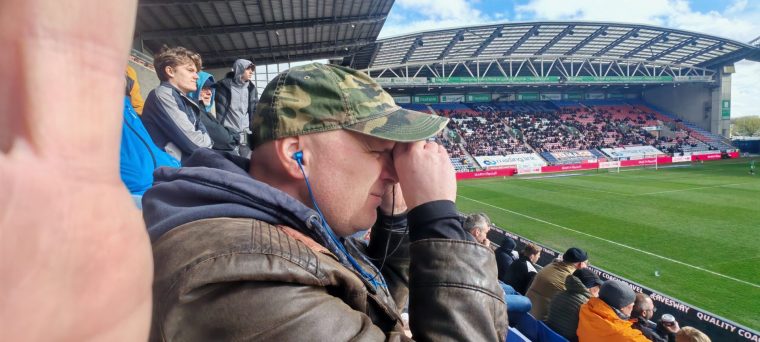
Walk a mile in someone else’s shoes. For Wigan vs Mansfield, Matt has provided me with glasses that convey his exact sight loss profile: large black areas in the centre of vision and then deep blurring around them. Matt also struggles with certain colours appearing the same and depth perception, things that cannot be adequately replicated.
He uses a small telescope device held up to his left eye (which has slightly better vision than his right) to get a clearer view of the ball. The small field of vision means that when a pass is played forward, he scans to the penalty area and waits for a chance to give himself the best chance of seeing a goal.
Pathetically obvious statement: it is nearly impossible for me. I can follow some of the sideways and backwards passing, but as soon as the next move becomes unpredictable I am lost. The exception, pleasingly, is Wigan’s winner. A penalty allows me to gain some focus on the ball and see which way it is aimed.
You really need the audio description
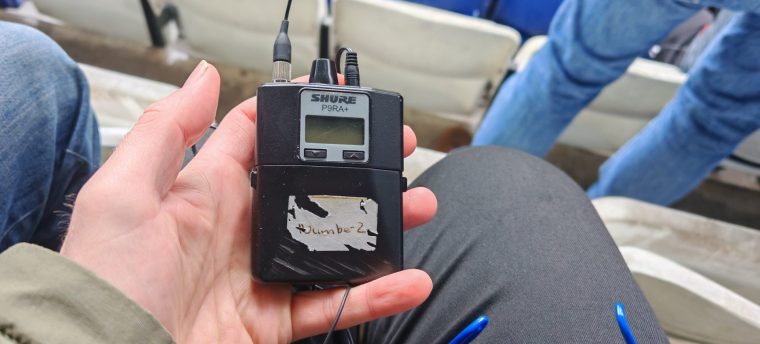
To assist Matt, me (today) and other visually impaired supporters, football clubs have audio commentary in headsets. These are split into two forms: general match commentary and audio description commentary.
There is a crucial difference, as Matt is keen to reinforce. Radio commentary – which he loves at home – offers insight on the action. Audio description, most helpful for blind supporters, provides a frame of reference.
Matt needs to know where the ball is on the pitch (the old grid system – “Back to square one” – was actually very useful). He needs to know where passes have been directed. Good radio commentary contains deliberate periods of silence but, for Matt and others, when he’s at the match silence is darkness.
At Wigan, I don’t find the commentary helpful enough. Everyone is trying their best but it’s certainly not an ideal audio description. You hear random words uttered alone – “bodies”, “chance”, “movement” – and have no context for what they represent visually. It is frustrating and I am only playing at this for one afternoon.
Every club should have to provide it
The audio commentary occasionally cuts out and dips in volume. Matt’s batteries run out – it would be nice if fully recharged ones were used to avoid missing a couple of minutes, but replacements are at least included in the pouch.
And at least Wigan actually provide audio headsets with commentary. I can’t quite believe it when he tells me – probably my own privilege showing – but there are Football League clubs that do not offer the service. Matt has been in away ends behind the goal (and so basically unable to follow action at the opposite end) with nothing to assist him.
Given the money required to implement it and the money wasted across other areas of a club, that is a scandal that must be addressed. Every professional football club in England must provide a full audio description commentary as part of their charter to have their licence approved.
The crowd noise helps
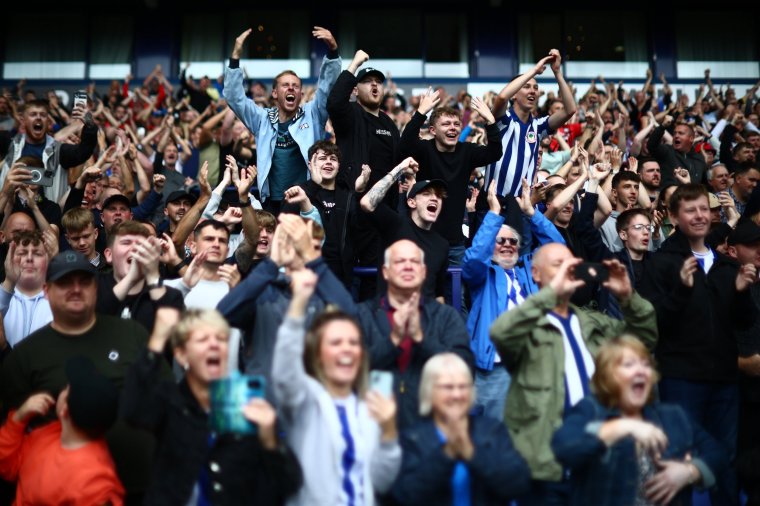
After the first 20 minutes, when I’m struggling to create any mental picture at all of what is happening in front of me, my brain begins to use other information that is usually football’s white noise (Matt told me that this would happen).
The referee’s whistle helps. Obviously it signals a break in play, but the severity or repetition of the sound can indicate the severity of a challenge or a melee between multiple players.
The crowd helps more. A jeer indicates that a misplaced pass or shot has missed its target by some distance. There’s a specific type of applause for a passing move, defensive certainty or a failed attempt. Certain subconscious shouts – “man on”, “offside”, “play it”, pressure him” – create synaptic links and produce small windows of context.
Technology holds the key to improvement
If the present is audio description (where provided), the future is far more ambitious and optimistic. Crystal Palace and Dundee United have trialled technology that provides a headset to stream match footage in real time with no latency issues. For Matt, that would provide a clearer picture with the real-life sound of the match in sync with his view.
Japan has also developed an AI-powered tool known as the “AI suitcase”, which uses a tracker in the ball and vibrates to tell visually impaired supporters where the ball is on the pitch. It was trialled during the regular NFL season in 2025 and offered a number of blind supporters at the Super Bowl the chance to absorb the game differently.
Either or both would be welcomed by Matt and others. There are possibilities to supercharge the experience. Inevitably these would occur at elite clubs first, but there is no reason why the 5G network can’t be strong enough in every ground to avoid delay issues with headset streaming.
Read more
- Daniel Storey: Gateshead and the greatest escape in English football history
- Daniel Storey: How Southampton accidentally stumbled on a golden ticket
Football must do better
Matt is keen to namecheck some clubs that do things very well. At Lincoln City, he was welcomed, talked through the headset system with his son and shown around the ground to ease accessibility. Cambridge United have the best audio description and the commentator made points to Matt by name to ease his experience. At Nottingham Forest, audio headsets were brought to his seat.
But elsewhere, far less help. Batteries die with no replacement provided. Stewards advise him to walk back to a ticket office in an unfamiliar location. “What do you want me to do about it?” is a phrase Matt has heard too many times. He’s been asked to sit in disabled bays rather than with his friends and family.
And that isn’t good enough. If you purport to care about supporters, you must help all of them. Matt shouldn’t have to battle for a good experience. A study by Unadev, a French blindness charity, revealed that 73 per cent of sports fans with some degree of sight loss don’t attend matches due to accessibility issues.
“It’s not that people don’t want to help,” Matt says. “It’s that they don’t think at all. And that makes you feel different and less valuable. We’re not asking for a lot here.”