





















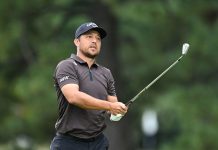



Trophies carry one name, but a champion is never built alone. For Kurt Kitayama, the quiet, unassuming golfer from Chico, California, now a two-time PGA Tour winner, the people behind him tell a story just as compelling as his swings on the course. That means his Japanese-American family from Northern California, a deeply personal caddie connection, and a bond with his grandmother that changed everything.
Who are Kurt Kitayama’s parents, Clifford and Rumiko Kitayama?
Kurt Kitayama grew up under the steady guidance of his parents, Clifford and Rumiko Kitayama. Clifford, an established entomologist who built his own business, was raised in Redwood City, while Rumiko moved to the United States from Japan.
Their support, however, wasn’t immediate or unquestioned. Rumiko initially struggled to see golf as a stable career path. She encouraged Daniel, Kurt’s older brother, to prioritize college over chasing the uncertainty of professional golf.
“I used to think that a golf professional was not a real job,” Rumiko laughed as she shared why she was hesitant about Kurt getting into the sport.
What shifted her perspective came from within the family itself. It was Clifford’s mother, well into her 90s, who reassured Rumiko that there was nothing wrong with letting the boys pursue the sport.
Years later, when Kitayama broke through at the Arnold Palmer Invitational in 2023, Rumiko could hardly process the moment. She described it as an unbelievable moment. Since then, both parents have made it a point to follow their son whenever and wherever possible.
Who is Kurt Kitayama’s brother, Daniel Kitayama?
Daniel Kitayama’s role in Kurt’s journey goes far beyond that of an older sibling. A former college golfer at the University of Hawaii at Hilo, Daniel built his life around the game, eventually working as a caddie at Bandon Dunes Golf Resort in Oregon.
When Daniel began visiting the course at eight, a three-year-old Kurt insisted on going along. And Daniel’s belief in his younger brother never wavered. He often pointed out that Kurt doesn’t quit once he sets a goal, committing to it fully.
The two brothers share a very close bond. In his early years, Daniel served as Kurt’s caddie, and their occasional playful fights always lightened the mood. “I think Kurt fired Daniel more times than I can count,” their mother shared.
View this post on Instagram
That connection became central again at the 3M Open last year. When Kurt’s regular caddie was unavailable, he turned to Daniel. The decision paid off after Kitayama’s three-shot victory. Kurt later credited his brother for helping him stay composed, think clearly, and navigate pressurizing situations. The win, he admitted, felt more meaningful because they experienced it together.
Kitayama’s support system extends beyond family and the course. In December 2025, he proposed to his long-time girlfriend, marking another deeply personal milestone in his journey. While he has kept much of that part of his life private, those close to him describe her as a steady presence through the ups and downs of professional golf, someone who has been there well before the trophies and headlines, and who continues to be part of the foundation he leans on. The two got engaged last year in November.
View this post on Instagram
The Caddie: Tim Tucker
If Daniel is Kurt’s bridge, Tim Tucker became his stabilizing presence. Their connection traces back to Bandon Dunes, where Daniel and Tucker had crossed paths. When Kurt needed a caddie in early 2023, Daniel brought them together at exactly the right time. Tucker, who happened to be in Phoenix, joined him for the WM Phoenix Open, and the partnership began almost instantly.
Tucker wasn’t new to high-pressure golf. He had previously worked with Bryson DeChambeau on eight Tour victories, including the 2020 U.S. Open.
View this post on Instagram
With Kitayama, he found his way back. During the final round of the 2023 Arnold Palmer Invitational, Kitayama’s triple bogey on the ninth could have unraveled everything. Instead, Tucker kept it simple, reassuring him that he still looked composed. That calm intervention helped Kitayama reset and ultimately close out the win, just three starts into their partnership.
From the beginning, Tucker believed Kitayama had elite-level talent. In his view, only minor improvements were needed to make him a consistent contender.
“I thought he was world-class,” Tucker said. “I told him you need to clean up the driver, and these guys won’t be able to touch [you].”