

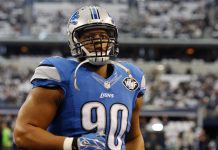







“You’d have to ask them. I’ll leave it at this, I don’t necessarily feel the love.” That was how Ndamukong Suh responded last year when Kay Adams asked if he believed the Detroit Lions did not value him. Unlike figures such as Barry Sanders or Calvin Johnson, Suh didn’t have a strained post-retirement relationship with the franchise.
But given that Detroit moved on from him after his rookie contract, his stance has remained direct and consistent regarding how he views that phase of his career. This week, when asked whether he would have preferred to spend his entire career in Detroit, Suh offered a measured response, pointing back to the business dynamics involved.
“Hindsight, yes, my goal was to stay in Detroit,” Suh said. “The 2014 season was absolutely amazing. I felt like we had an opportunity to win a Super Bowl that year. And Jim Caldwell, I didn’t want to leave him being my head coach. And just the way he empowered me and everybody from the team, by no means did I want to leave. But also at the same time, I got to do what’s best for my family. And they didn’t care to see me as a cornerstone of their defense, let alone their team and the organization. And so business is business at the end of the day.”
“By no means did I want to leave, but at the same time, I gotta do what’s best for my family.”@NdamukongSuh looks back on leaving Detroit pic.twitter.com/KUTxxxxFoo
— 4th and South (@4thAndSouthPod) April 8, 2026
The Lions drafted Suh with the No. 2 overall pick in the 2010 NFL Draft at a time when the franchise had a combined 2-30 record over the previous two seasons. Alongside Matthew Stafford and Calvin Johnson, Suh played a central role in stabilizing the team’s trajectory.
By his second season, Detroit recorded double-digit wins for the first time since 1995 and returned to the playoffs for the first time since 1999. Suh quickly established himself as the defensive focal point, recording 10 sacks in his rookie season, earning Defensive Rookie of the Year honors, and contributing to two playoff appearances during his tenure.
Following his early success, the franchise exercised his fifth-year option. However, when extension discussions began, the two sides failed to align on valuation. Suh later revealed that he allowed the Lions to match external offers, which the organization declined.
The situation gained further context when reports from The Detroit News indicated that Detroit offered a deal worth up to $102 million over six years, with an average annual value of $17 million and $58 million guaranteed. The structure, however, did not meet Suh’s expectations.
For additional context, Suh also expressed frustration with the internal pay hierarchy, noting that the Lions prioritized Stafford financially. Following his rookie deal, Stafford signed a three-year, $53 million extension with $41.5 million guaranteed. Suh viewed himself as the next cornerstone player in line for a comparable commitment.
“Detroit, in my opinion, when I first came out, really gave me the short end of the stick,” Suh said last year. “I should have been paid more than Matthew Stafford, because I was the next first-round pick for them coming out in the draft and I felt like I was going to be a cornerstone for them, but they didn’t value me enough to say, ‘Hey, you’re not going to get paid more than our quarterback…”
Ultimately, Suh’s tenure in Detroit concluded after five seasons. During that span, he earned four Pro Bowl selections and recorded 36 sacks, 238 combined tackles, 66 tackles for loss, and one interception across 78 starts. While the Lions did not meet his contract expectations, the Miami Dolphins did, securing him ahead of the 2015 season.
Ndamukong Suh wanted to return to Detroit despite Miami’s deal
When the Lions did not extend Ndamukong Suh, he entered free agency ahead of the 2015 season. Once on the market, he drew multiple offers, including from the Dolphins and a higher bid from Oakland. Despite that, Suh prioritized allowing Detroit to retain him. He explained:
“I remember vividly I was leaving church on a Sunday. My agent calls me and he’s like, ‘Miami’s got an amazing deal. Oakland has got a million dollars more, but I know you’re all about taxes and actually the true money that you get to give.’ Sounds like Miami, but I still want to give Detroit an opportunity to match. If they match right here, right now, I’ll come back to Detroit. It was ghosts.”
He went on to close out a career that spanned over a decade, finishing with 71.5 sacks, 130 tackles for loss, and a Super Bowl championship. While his post-retirement stance toward Detroit is not overtly contentious, his comments suggest a clear distance from the franchise that originally drafted him.