



















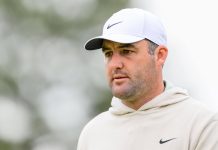






On Sunday at Augusta National, the scoreboard showed a clear story: Cameron Young had ten birdie chances on the back nine but didn’t make any, and he never closed a two-shot gap. That sums up his Masters in the simplest way. But when Young spoke to the media afterward, he shared what it was really like to play with Rory McIlroy in the final group, something the numbers alone couldn’t show.
“Not trying to be best friends out there.”
McIlroy hardly spoke to him all day, and Young was fine with it. That was how Young described his Sunday in the final group. There was no tension or animosity, just the reality of competing next to a back-to-back Masters champion who knew exactly what he needed to do from the start.
“There is not much. I mean, I’m not one to talk a ton to begin with, and I don’t think he really wanted to talk to me today. Sunday at the Masters in the final group, you know, don’t wish anything poorly on the guy, but we’re playing against each other.”
McIlroy let his golf do the talking. Birdies on 12 and 13 helped him seize control on Sunday and move toward the title. The silence Young mentioned was not a lack of courtesy but a deliberate approach. McIlroy had spent years understanding what it takes to win at Augusta on a Sunday, and in 2026, he showed up prepared.
Young came into the week as the defending Players Championship winner and kept up that strong play on Sunday. He started well, shared the lead through the front nine, and looked as dangerous as his ranking suggested. He stayed in the hunt through the front nine before McIlroy’s back-nine response turned the final round.
Young recognized McIlroy’s performance but did not attribute the outcome to being outclassed. When asked if there was anything to learn from playing with a six-time major winner, he kept his response factual and direct.
“He’s obviously a great player. I watched him play three rounds this week. I think if you asked him he would admit that he didn’t drive it particularly straight the first two days and did some incredible scoring. Some of that is down to the randomness of golf. Sometimes you hit a bunch wedges close in a row. Sometimes you don’t.”
Young was clear. He pointed out that McIlroy’s performance was not about flawless play, but about finding ways to score even when things were not perfect. McIlroy managed crooked drives, made key pars, and took birdies when they mattered. This ability to get a result, regardless of ball-striking, now defines McIlroy at Augusta. Young is still working toward that. Before the tournament, Young set a realistic goal: to be ready to play late on Sunday, not to win, but to be prepared.
Young’s mental coach described his Players Championship win as a lesson in staying present. That composure remained on Sunday, but the putts did not drop.
“I would like to look back on this week more in the sense of I played great, well enough to win, and it just didn’t quite fall my way this time.”
Young finished T3. He recognized what separated him from McIlroy and was direct about it.
Cameron Young’s Masters record echoes Rory McIlroy’s own Augusta journey
By the end of 2026, Young has six top-10 finishes in 17 major tournaments, but still no wins. He missed the cut in 2022, finished tied for seventh in 2023, tied for ninth in 2024, missed the cut again in 2025, and now has a tie for third. His story is familiar: great ball-striking, always in the mix, but just missing out at the end.
McIlroy went through a similar journey for more than ten years before 2025. He led the 2011 Masters by four shots after three rounds but struggled on the last day. Over the years, he finished second in four majors, always close but never winning. Eventually, Augusta gave him the win he had been chasing. The quiet that Young felt on Sunday was shaped by that history—a player who had lost here enough times to know that talking during the final round at Augusta is a rare privilege.
Young understood what McIlroy’s silence meant, maybe better than any TV coverage could show. It wasn’t arrogance or coldness. It was the total focus of someone who had already proven himself at Augusta and was doing it once more. Young is still searching for his own answers, but after this week, he seems closer than ever.