



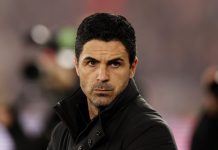




















The mad panic is inescapable now. Whether it starts with Arsenal wobbling to provoke external pressure, or external pressure that provoked an Arsenal wobble, is a moot point. It now exists as a whirling vortex and the only way to extinguish it is to win, win, win.
And yet the same panic is also almost entirely superfluous. Arsenal have won their last four league games: north London derby, Chelsea, Brighton away and Everton at home, one of the best away teams in the country. They are the Champions League favourites. Beat Crystal Palace, Bournemouth, Burnley, West Ham and Fulham and they are likely to win their first league title in 22 years and they won all five of the reverse fixtures. Life is good!
Arsenal are not the first team to learn that participation deep into multiple competitions can be a curse, not because of the workload but for how it shifts expectation beyond control. Quietly bowing out of the domestic cups in November and February causes far fewer ripples when you are ahead of the curve in your priority competitions.
Southampton are ahead! Unbelievable scenes at St Mary’s
Watch live on TNT Sports and HBO Max pic.twitter.com/0oeiyVTTo2
— Football on TNT Sports (@footballontnt) April 4, 2026

The specific complication here: pressure is a self-fulfilling prophecy and Arsenal – and Mikel Arteta – are already fighting against a tide of supposed self-fulfillment. That’s partly because of their competition; “What if City win 10 league games in a row?” we ask about a team that hasn’t done more than six since 2023-24.
But mainly, saliently, it reflects the perception of this Arsenal and this manager: fragile, over-emotional, suffocated by their own proximity to intended destiny. Any setback at any time means more. Shuffle your papers and prepare to prosecute. Release all the memes.
Plenty of this is hyperbolic bluster that will make little difference to what happens between now and June. But what certainly does matter is how Arteta deals with each of these setbacks, for nobody gets through a season without being hurt.
What I find most fascinating about Arteta in these moments is how much he focuses on attitude, character and personality rather than specific focus on tactical issues. After the Wolves draw, he spoke first of needing to “go through the pain and look in the mirror”. After the Carabao Cup final, “poison in the tummy” and “fire in the belly”. On Saturday evening, it was “let’s look at ourselves in the mirror” again.
These are presumably deliberate public simplifications (nobody is saying that Arsenal aren’t privately hyper-focused on tactical points), implicit insistences that the players are good enough but just need to realise it. But they are also the usual sound bites of a firefighter in charge of a team trying to stay in a league, not win it.
Read more
Is your own manager discussing fuel, fight, fire and staring into your own face likely to calm everybody down or whip up the storm even more and force a team encircled by pressure to play more on the edge? At the bottom that can help, but at the top? According to Opta, Arsenal have conceded eight goals in their last 23 games directly resulting from individual mistakes; it was one in 28 matches before that.
It’s also risky because if it fails to work it makes inferences about players’ character and stomach, precisely the things that people were questioning anyway. If you publicly tell a group that fire in the belly is the antidote to losing to Manchester City and you immediately lose to Southampton, it clearly did not work. How long can you stare at yourself in the mirror before you go cross-eyed?
So the storm simply whips up again. Sporting Lisbon in midweek is not just one game because none of them are now. Instead they are all piled up into a mountain left to conquer, a giant left to slay, a vast hall of mirrors that warps your strengths and doubts in reflection. The only way to disprove what everybody says is to prove it to yourselves.