



































A debate that refused to stay local
The global popularity of F1 has significantly grown, but the majority of the drivers come from European countries. According to Larson, Americans don’t often get the nod when it comes to being world-class drivers in motorsports.
“I think Americans in general don’t get the respect that they deserve from Europeans in any form of sport. They’re not paying attention to what we’re doing over here in America, and rightfully so, that’s fine, whatever,” the 2025 Cup Series winner said. “They don’t think that there can ever be another driver as good as the worst Formula 1 driver.”
His previous comments on Verstappen opened a debate and caused an obvious divide between F1 and NASCAR, but when asked about what he really thought about Verstappen’s driving, the HMS driver was full of praise.
“He’s extremely good. He gets the praise from so many people; you have to accept that, yes, he probably is the best,” said Larson. “What he does is amazing, even his teammate is never even on the same stratosphere as him,” he said.
While the real answer is not something that will ever be found out unless Verstappen decides to make the move to stock car racing, his driving prowess is known to all. The F1 car is completely different from NASCAR; both require different sets of skills, which is why it is tough to identify who the better drivers is among the two.
The impossible standard of comparing cross-disciplinary drivers
The debate between who is the better driver, Larson or Verstappen, collapses at the very first question: how is their greatness being compared? The issue is that F1 and NASCAR are fundamentally different races that test different skills. F1, for example, gives higher priority to single-lap extraction, tyre thermal windows, ERS deployment, brake-by-wire modulation, and operating under parc fermé restrictions that severely limit how much you can modify your car after qualifying.
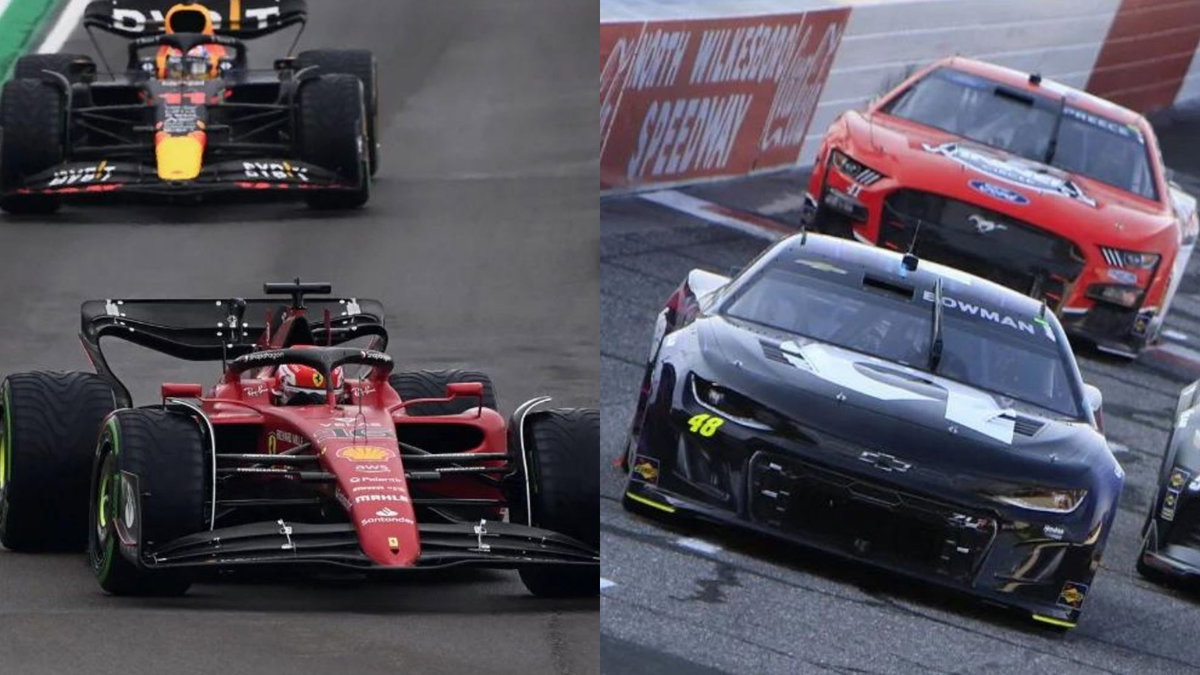
NASCAR, on the other hand, emphasizes traffic management, restarts, pack racing, side-drafting, and long-run tyre falloff.
Even the development pathways differ. The FIA Super License system requires 40 points, awarding 40 for an IndyCar title, yet only 15 for a NASCAR Cup title.
Thus, the metrics between both forms of racing are severely incompatible. There exists no unified way to measure the two drivers, each excelling within entirely different systems. The debate, therefore, is not a contest with a clear winner, but a structural mismatch, one that ensures the question remains open rather than resolved.