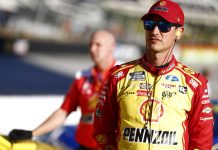

























Long before the championships and the eventual dominance showcased, Jimmie Johnson‘s trajectory was anything but predictable, yet it had been mapped long before. His own recounting of his long journey makes the fact very clear that he was destined to be a NASCAR legend.
Johnson took a huge leap
Johnson appeared on Kenny Wallace Media’s Lights out show, where he spoke on his path to NASCAR, which was different from a lot of other drivers.
“As everybody knows, I had strong support from Chevrolet in my early years in off-road racing, and I believed my path was leading toward IndyCar,” said Johnson. “There were strategic moves coming into place, the GM was heading up, they made a decision to exit IndyCar racing in the mid to late 90s, and when that pathway wasn’t going to yield for me, the head of Chevrolet Racing, Herb Fischel, told me, ‘You need to think about NASCAR. You need to find a pathway there.’”
Why @JimmieJohnson almost went in a different direction than #NASCAR
From “Lights Out With @TheJohnnyTV” pic.twitter.com/yl8advsumO
— Kenny Wallace Media (@KWallaceShow) April 9, 2026
Safe to say, that decision proved to be fruitful as Johnson went on to win seven Cup Series titles, becoming one of the most successful NASCAR drivers of all time. However, it all came after the risk he took in 1997, aged just 22.
“I bought a one-way ticket to Charlotte, had some friends that I knew would offer me a couch, that was Ron Hornaday, and I bought a one-way ticket in April 1997 and have been here since,” said Johnson.
His move to Charlotte could have gone either way, but Johnson took the leap, and the turnaround worked out well for him.
“One thing I try to pass on, especially as a parent, is that the road is rarely clear,” he added. “But if you’re passionate about something, you pursue it. That’s what I did. I never knew exactly where I would end up, but I knew this industry was where I belonged. I was fortunate to be in that small percentage that made it, but I would have been just as content wherever the journey ended, as long as I was part of the sport.”
All of Johnson’s hard work and what he is today seems to boil down to one core decision: moving to Charlotte. But what’s the importance of this suburb in NASCAR?
The Charlotte hub and its importance in NASCAR career building
Many legends, such as Richard Petty, Kyle Busch, Tony Stewart, Dale Earnhardt, and even his son Earnhardt Jr., made their name in the sport due to Charlotte.
The region sits within a day’s drive of a majority of NASCAR’s traditional southeastern tracks: Daytona, Darlington, Bristol, Martinsville, and Atlanta. Before chartered flights, these tracks in proximity allowed teams to travel to multiple destinations with reduced costs and turnaround time.
Charlotte gave local talent unprecedented and disproportionate access to the machines. In fact, by around the 2000s, around 90 percent of top-tier NASCAR teams were already based within the region.
NASCAR formally relocated to Charlotte in 2014, but long before that, the operational control existed in that exact city. Even manufacturers like Chevrolet and Ford have their racing divisions quite nearby, which allows their drivers to directly target OEM pipelines.
Even the developmental ladder for NASCAR almost entirely exists in the state and the surrounding states. From late models to regional circuits to ARCA affiliations, everything was there, allowing drivers to stay visible.
Additionally, the region has a very rich racing culture. Fans come out in huge numbers for races, and this has, in itself, contributed to the tracks in this region gaining huge popularity. It is difficult to imagine any other region taking over the reins from Charlotte, as NASCAR is deeply rooted there.