























April 26, 2011. Lindy Ruff’s Buffalo Sabres lose Game 7 to the Philadelphia Flyers in the first round. That same year, Rex Ryan’s New York Jets went 8-8 and missed the playoffs. Two franchises, two sports, two different cities, but with the same result. Neither had been back near the playoffs since. For fifteen years, that shared failure was the one thread tying them together. And on Saturday, April 4, it snapped.
The New York Rangers beat the Detroit Red Wings 4-1, and the Sabres clinched their playoff spot without suiting up, ending an NHL record of a 14-season drought. To put things into a greater perspective, it had been 5,458 days between that April loss in Philadelphia and Saturday’s playoff berth. Through it all, the Sabres finished last in the entire league four times, went through six coaches and three general managers. The latest GM, Jarmo Kekäläinen, walked into the job in December with the team sitting dead last in the East.
What followed was a major rebuild. Buffalo went 35-9-4 from that December low, matching a franchise record with a 10-game winning streak along the way. With six games still left, they sit 46-22-8, tied for first in the Atlantic Division and in contention for the conference’s top seed.
After Saturday, captain Rasmus Dahlin has 67 points, and forward Tage Thompson has 38 goals. Goalie Ukko-Pekka Luukkonen, who shook off an early injury, is 15-4-2 since December 21. By any means, this isn’t a team that’s sneaking into the playoffs. But where does that leave the Jets?
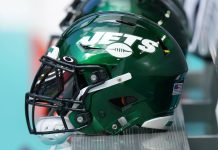
The New York Jets now have the longest North American professional sports playoff drought.
They broke the record today after the Buffalo Sabres clinched an NHL playoff spot.
— Polymarket Sports (@PolymarketSport) April 4, 2026
For years, every Jets faithful had a line: at least we’re not alone in this. But that’s done now. New York already held the longest active playoff drought in North American professional sports, with the Sabres coming in second. But now the Jets sit by themselves in that drought, and nothing about their 2025 season suggests that that wait will end anytime soon. Head coach Aaron Glenn took over a franchise that had already lost for nine straight years. Year one under him went even worse.
The 2025 Jets didn’t just lose; they made history doing so. New York became the first team in NFL history to finish last in point differential, turnover differential, and total yardage in the same season, 32nd in all three. Their final season record of 3-14 was only half of the nightmare.
The season opened with seven straight losses. The three wins came against losing teams starting backup quarterbacks. They closed the season by losing five straight games by at least 23 points, something no NFL team had ever done over four consecutive games since 1972. When it was all over, the Jets became the first team in NFL history to go an entire season without recording a single interception on defense.
The quarterback room didn’t hold either. Justin Fields got benched, and backup Tyrod Taylor got hurt filling in. Brady Cook lost the last five games of the season. With three starters in one season and zero defensive turnovers, this was a roster falling apart from multiple directions at once.
Off the field, things got darker midseason. Aaron Glenn and GM Darren Mougey traded cornerback Sauce Gardner to the Indianapolis Colts and defensive tackle Quinnen Williams to the Dallas Cowboys at the trade deadline. Glenn fired defensive coordinator Steve Wilks after 14 games into the season. Current cornerback Kris Boyd was also shot twice outside a Midtown Manhattan restaurant in November. By December, it had stopped being just a football story, and AG cleaned house again in January. He cut seven assistants and eventually parted ways with offensive coordinator Tanner Engstrand as well.
One call stuck from the season in particular. Week 6 in London against the Denver Broncos, down four with about a minute left in the first half, the Jets had just converted a fourth and 1 at their own 37-yard line. Glenn let the clock run with short passes and run attempts. No Hail Mary, no attempt at staging an offense. The Jets went to the locker room trailing 10-6. On the way in, Garrett Wilson was visibly animated on the sideline with Glenn. The Jets lost that game 13-11, and fell to 0-6. That reluctance to make plays was the Jets’ whole season in a nutshell.
After losing a third straight game by more than 20 points in December, even Aaron Glenn had to address what was left of the goodwill.
“For the fans, listen, it’s going to be a tough road,” Glenn said. “We knew that, but, man, the thing is, we know exactly what we’re doing. We have a plan. Just don’t let go of the rope, I would say that.”
That statement will either look like a prophecy or an embarrassment by the time 2026 is done. Glenn inherited nine straight losing seasons and went 3-14 in year one. Asking fans to trust the process at 3-12 takes either genuine belief or genuine stubbornness (possibly both). This March, he said that he spent time in the offseason in deep self-reflection. But only the draft and the season beyond can actually fix that 15-year playoff drought.
What Aaron Glenn is doing about it
The Jets hold the No. 2 overall pick in the 2026 NFL Draft, along with the 16th (from the Gardner trade), 33rd, and 44th (from the Williams trade) picks. Darren Mougey and Aaron Glenn covered about 5,800 miles in six days this month, visiting Miami, Notre Dame, Ohio State, Texas Tech, and Alabama to evaluate draft prospects in person. The jets haven’t moved so aggressively in years.
The biggest spotlight so far has landed on Alabama’s Ty Simpson, the consensus No. 2 quarterback in this class. The Jets travelled to Tuscaloosa for a private dinner and workout with Simpson, bringing Mougey, Glenn, offensive coordinator Frank Reich, and quarterbacks coach Bill Musgrave.
They also dined with Miami’s Carson Beck, worked out Penn State’s Drew Allar at their facility, and have a private visit scheduled with LSU’s Garrett Nussmeier. They’ve even looked into UConn’s Joe Fagnano, who threw 28 touchdowns against just one pick last season. For Aaron Glenn & Co., this is a full audit of the quarterback position.
However, ESPN’s Rich Cimini believes the team is also leaning towards Ohio State linebacker Arvell Reese for their No. 2 pick. Reese is 6-foot-4, 241 pounds, ran a 4.46-second 40-yard dash, and can even play inside and outside linebacker in the same game. Glenn, per Cimini, is “planning to employ multiple fronts, including a new 3-4 look.”
Glenn has also compared Reese’s college production (6.5 sacks in 97 pass rush snaps) to how Danielle Hunter looked coming out of college. The Houston Texans’ veteran DE has logged 27.0 sacks for the team in just the last two seasons.
“His stats weren’t up there, but he had all the traits, and he’s had a coach that can coach him to be where he’s at right now,” Glenn noted about Hunter, before moving on to Reese. “So I look at [Reese] the same way. Man, it’s a combination of the traits, and this combination of the football character again. Is that a player coachable enough to be able to do the things that you want him to do to be successful?”
“I just feel like he’s the guy that’s going to lead us to the promised land,” Glenn said.
The organization has also poured $40 million worth of guarantees into Minkah Fitzpatrick, Demario Davis, and David Onyemata. Glenn was candid about what that meant: those players “bring a certain level of adult to our team that we need.”
Wide receiver remains the most visible gap for NY. To fix that, Mougey has reportedly explored trades for Brian Thomas Jr., Rashod Bateman, and Quentin Johnston. The free agency has already shown the Jets being aggressive on both sides of the ball, and the draft is where it all pans out next.
The Sabres went through 15 years of disappointment before they finally got out. The Jets are alone on that list with a second-year head coach and a roster being rebuilt on the go. Aaron Glenn seems to have a plan. Whether it holds together is the only question that matters when September rolls around.