













Cup star revives veteran after downfall
“No, Lewis, TJ Sports, Connor, can you just give us a glimpse at what it’s like to work with a guy like Rodney?” A question by a reporter that reads quite simple, but behind it is a troubled history ending in salvation for the famed crew chief.
“Yeah, man, it feels good. It’s been a while since Rodney’s been in Victory Lane, and I know how bad he wants it, right?” said Connor Zilisch, and that “while” is not abstract.
After the crew chief ended his championship-winning run with Kevin Harvick at Stewart-Haas Racing, a partnership that was so enticingly successful that it delivered the 2014 Cup title and over 40 wins to the team, yet the exact success came crashing down overnight while Childers was forced out due to SHR’s shutdown.
.@ConnorZilisch was very happy to be the driver to bring @RodneyChilders4 back to victory lane.
Here’s what he told me:#NASCAR pic.twitter.com/20IbF6mKdS
— Noah Lewis (@Noah_Lewis1) April 12, 2026
“A lot of guys, a lot of teams in the Cup Series wrote him off,” Zilisch continued. That perception was accelerated by what followed next. Childers’ move to Spire Motorsports in 2025 was nothing short of disastrous. In fact, it was so bad that the stint became one of the shortest and most underwhelming crew chief stints at the Cup level that season.
The pairing with Justin Haley failed to generate competitive results. The results were too disheartening for the crew chief, who was only able to produce a single top 10 finish before a mutual split was decided between the parties just weeks into the year.
Zilisch continued, “They said that he didn’t work as hard anymore, he didn’t want it as bad anymore, he’s at the back end of his career,” before adding, “And, you know, I got to work with him firsthand this year, I’ve gotten the opportunity to see how hard he works, how smart he is, and how much he loves the sport.”
Zilisch also acknowledged the effort of this chief as he stated, “And it’s been really, really cool to see that firsthand, and I’m really glad to be the one to get him his first win here with JRM.”
And in just those two conclusive lines lies a full arc. A fall followed by absence, doubt, and now eventual victory for the chief. This was firsthand possible only because JR Motorsports decided to take a leap of faith and appoint a forgotten chief as its leader. But why would they do that? After all, it escapes reasonable critique for a feeder team to take such a monumental risk. Well, let’s find out the reason.
JRM’s structural shift: From feeder team to high-performance development system
The 2026 avatar of JR Motorsports has showcased a clear transition from what was a conventional feeder outfit into an altered high-performance developmental system. This is not just conjecture, but it all started with the appointment of Rodney Childers, a 2014 Cup Series championship-winning crew chief with 40 career Cup victories, to lead its No. 1 program, signed by none other than Dale Earnhardt Jr. to lead the program.
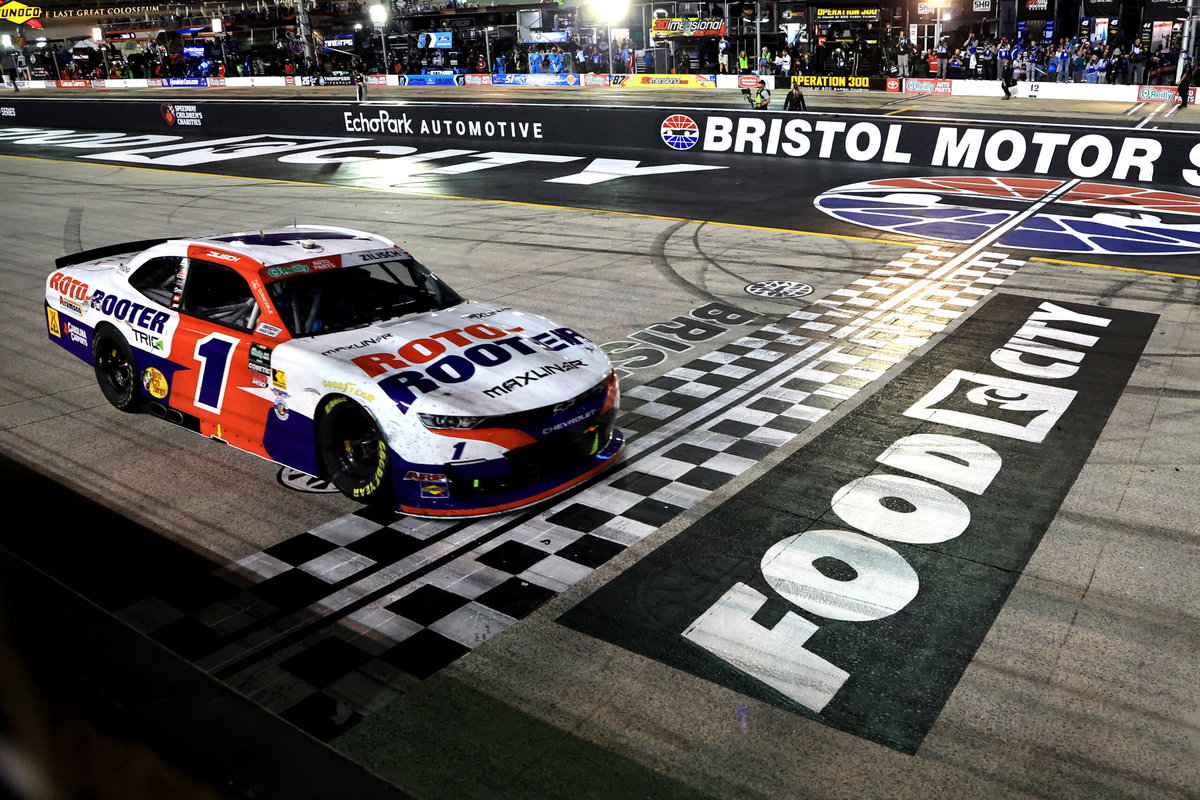
What makes this appointment even more interesting is the risk capacity that JRM operates with. Rather than granting a veteran driver to Childers, they have fed him novices that, even though they can catastrophically crash, may provide high upside if it works, such as Connor Zilisch and Carson Kvapil.
This symbolic realignment towards a more risk-laden strategy was also apparent at Bristol. Childers’ late-race call to maintain track position on older tires enabled Zilisch to hold off Kyle Larson, demonstrating immediate execution under pressure, seemingly an act that no feeder team would do.
What was even more interesting was the non-interference of the team in Childers’ decision. This was not only a showcase of confidence in their chief, who needed it a lot after his disastrous last year, but also in their own talent model.
Configurations throughout the team reinforce this outing. Take, for example, the No. 88 program, which integrated Mardy Lindley, who led a nine-win Championship 4 campaign in 2025, with developing driver Rajah Caruth, again aligning proven technical leadership with high-upside risk talent. Layer onto this the usage of benchmark drivers such as Justin Allgaier, which all point to a new direction that the team’s leadership has decided to steer in.
This architecture, moreover, is not just built out of nowhere; it is backed by a strong pipeline. JRM maintains a Late Model program feeding into Xfinity while also expanding upward, having initiated Cup Series participation in 2025. Historically, the success of JRM includes drivers such as Chase Elliott and William Byron, but the current iteration differs slightly from their archaic times. Right now, the team focuses on taking in data and experience from its multi-tier exposure and channeling it through a single unique ecosystem.
What has that resulted in? It has created a highly novel hybrid model that no team has envisioned yet, where JRM acts as part incubator and part competitive entity, where the sole focus is not development but instead the testing of that very development with constant execution. And after all, that is exactly what the fans want to see.