


































Rory McIlroy is at the center of the 2026 Masters, which is shaping up to be one of the most compelling. Through three rounds at Augusta National, he leads the field at -11. But for Collin Morikawa, currently sitting at T12 at -5, the question of whether #2’s presence changes how he approaches his own game has a simple answer: it doesn’t.
“Intimidating, Rory? I don’t know. When the guy is driving the ball lights-out, I don’t know if ‘intimidating’ is the word, but it’s a feat in itself, and it’s pretty impressive. But I’ve learned to figure out how to play golf courses myself, and when I’m on, I feel like I’m on,” Morikawa told the media.
These two golfers have a history beyond this week. At the 2021 CJ Cup, McIlroy edged Morikawa by a single shot. Off the course, when Morikawa skipped the media after a tough loss at the 2025 Arnold Palmer Invitational and drew public criticism, McIlroy defended him, saying that players are not required to speak post-round and that prioritizing mental well-being is essential.
McIlroy arrived at Augusta as the defending champion, having won the 2025 Masters, and opened this year with rounds of 67 and 65, the largest 36-hole lead in Masters history. He built a six-shot cushion over the field before a third-round 73 brought the pack closer. That’s what Morikawa is brushing off.
For Morikawa, the bigger intimidation factor at Augusta isn’t any individual player. It’s the course itself, the sheer scale of it, where, standing in one spot, you can see holes 1, 2, 7, 8, 9, and 18 all at once. This comfort comes from lived experience at Augusta.
In the 2024 Masters Round 3, he birdied his opening three holes, getting through Tea Olive’s tight tee shot and converting Pink Dogwood’s scoring opportunity immediately. And in the 2022 final round, on the 18th, one of Augusta’s most visually demanding closing holes, uphill, narrow, with bunkers guarding the approach, he holed out from the sand right after McIlroy did the same. He called it “the coolest thing in the world.” Those are the exact holes he described as visually overwhelming, and he has delivered on them when it mattered.
McIlroy’s 2026 numbers back up what Morikawa said. The Northern Irishman opened the week with rounds of 67 and 65, made 19 birdies across three rounds, and hit 66.7% of greens, but a third-round 73 showed that Augusta has its say even when you’re in control. He still sits at -11, tied with Cameron Young for the lead.
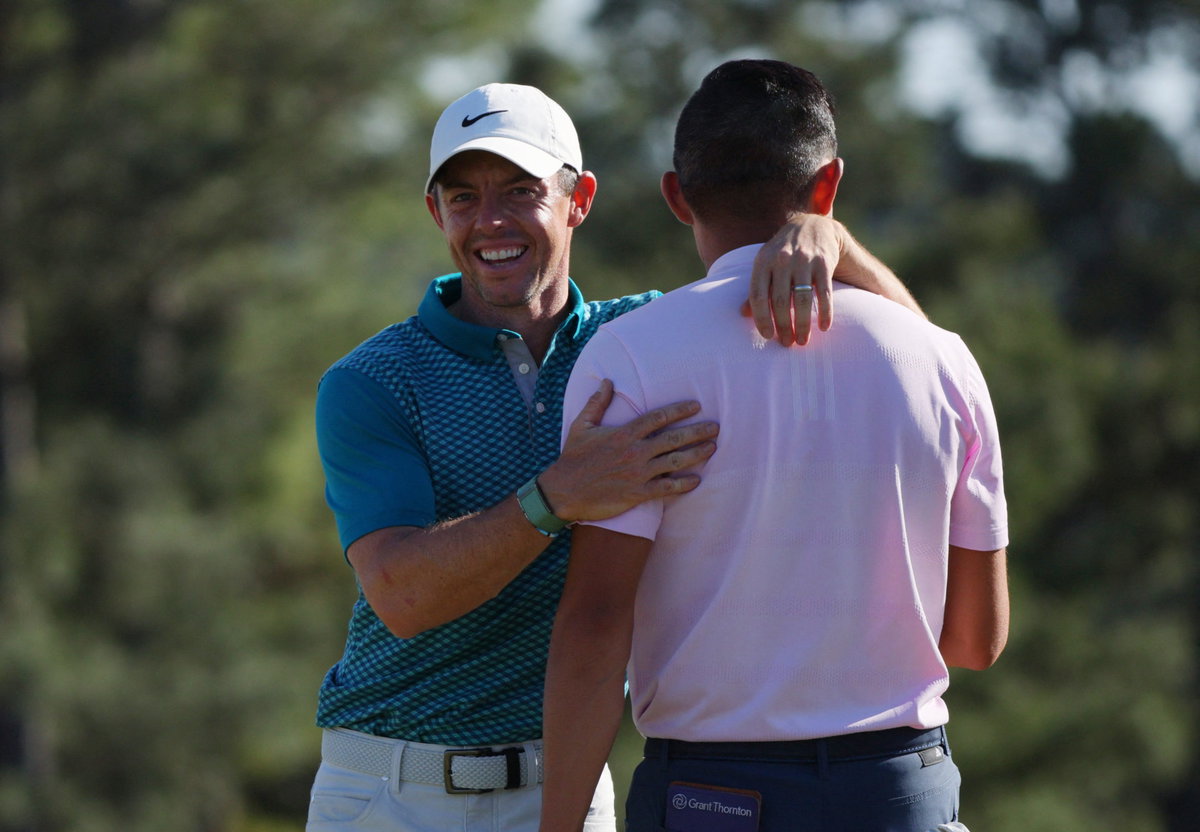
Morikawa has made the cut in all five of his Masters appearances since 2020, with three top-10s in his last four starts, a T3 in 2024, and a scoring average of 71.35 at Augusta. This week, he sits at T12 with 12 birdies, a 68 in Round 3, a driving average of 296 yards, and 68.5% greens hit. Six shots is a real deficit heading into Sunday, but his record here shows he knows how to close at this venue.
Morikawa’s composure this week holds greater significance than the scorecard indicates. The 29-year-old has been playing through a back injury that forced him to withdraw from the Players Championship after just one hole last month, and he has been open about his game at the Masters so far.
Collin Morikawa is playing the Masters through pain
Morikawa described his opening 74 as the toughest round he has ever played. But he also called his 69-68 bounce back among the best golf of his career. He has been managing a back injury that has limited him to roughly 50 percent swing capacity all week.
The physical toll was visible Saturday as he made his way up the hill from the 18th green, but the mental challenge has been the harder battle. Every morning this week started not with a game plan but with a checklist of whether his body would hold up long enough to reach the first tee.
Collin Morikawa never seriously considered withdrawing, and that decision alone says something about where his head is. Playing through pain at Augusta, where the elevation changes and the demand for full commitment on every shot is relentless, is a different test than grinding through a regular Tour stop.
The back may still be a problem. But nothing about this week suggests he is ready to ease off.