
















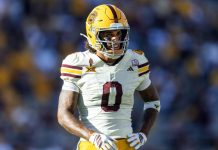
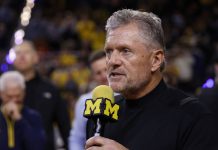










When Frank Ragnow retired last year, the expectation was that the Detroit Lions would honor one of the league’s best centers with something like the Ring of Honor or the Pride of the Lions in the future. That’s the path the franchise has taken before with legends like Barry Sanders and Calvin Johnson. Instead, despite everything he gave the organization, the outcome felt more in line with how those two were treated, just without the franchise honors. And that didn’t sit well with Jason Kelce of the Philadelphia Eagles.
For a broader context, Lions president Rod Wood confirmed at the annual league meeting that the team pursued repayment of part of Ragnow’s signing bonus after his early retirement. That explanation didn’t land well with Kelce. He took to X and pushed back, calling the repayment request unfair. Coming from a center who spent his entire career in Philadelphia as a six-time first-team All-Pro and seven-time Pro Bowler, his perspective carries weight. In his words:
“Frank was known for being hurt and playing through injuries most players wouldn’t play through constantly. Broken foot, a torn pec, multiple knee injuries, back issues. There was always something, and I’m sure he was continuously dealing with multiple ailments to try and continue playing the game. His body clearly had deteriorated to a degree that made football no longer a viable option, physically, and probably mentally.
“In my opinion, the signing bonus is supposed to protect players from future physical ailments limiting their availability on the field, that’s one of the reasons you want more guaranteed money upfront. So while I get that the team has a right to ask for money back, in the spirit of the agreement, I think it’s bullshit Frank is being asked to return money.”
This is interesting. It feels like it’s obvious that Frank retired because he was physically fighting through injuries and pain, and it got to a point that he no longer could play the game in an enjoyable, effective, or healthy way.
The whole purpose of a signing bonus is to… https://t.co/pvjgvLrsA0— Jason Kelce (@JasonKelce) March 31, 2026
Kelce’s stance is shaped by experience. He spent 13 years in the league and, when he retired, didn’t run into any repayment issues. It was a much smoother exit. But that also speaks to how differently teams operate. Some teams take a more player-friendly approach in the league. In Detroit, the precedent has been clear.
The Lions have followed this path before, and not just once. Sanders signed a six-year, $34.56 million deal with an $11 million signing bonus, only to retire two years later before the 1999 season. The Lions responded by taking him to arbitration and forcing him to repay more than $7 million of that bonus.
And this wasn’t just any player. Sanders was a first-ballot Hall of Famer. He was the franchise’s all-time leading rusher. And he was someone who eventually earned the Ring of Honor and Pride of the Lions. If he hadn’t retired when he did, he had a real shot at surpassing Walter Payton’s career rushing mark of 16,726 yards.
The same pattern showed up again with Johnson. A six-time Pro Bowler and a central figure in the Lions’ All-Time Team, he also earned a place in the Pride of the Lions. But when he stepped away before finishing his contract, the team required him to repay $1.6 million from his $3.2 million remaining signing bonus.
So when you look at the bigger picture, this isn’t new territory for Detroit. Even with players who shaped the franchise’s history, the organization has consistently enforced this approach. And now, that same precedent is being applied again. This time, it’s with Ragnow, who also chose to retire before his contract expired.
Inside Frank Ragnow’s contract and injury-forced retirement
Back in 2021, the Lions signed Frank Ragnow to a four-year, $54 million extension after picking up his fifth-year option. The deal included a $6 million signing bonus. And when he retired, he still had two years left on that contract. Per reports, that bonus was set to count $1.5 million against the cap from 2023 through 2026.
So, on the surface, it’s not hard to see the team’s side. From a contractual standpoint, repayment is reasonable, and Rod Wood’s stance follows that logic. But this is exactly where Jason Kelce’s argument starts to carry weight. Ragnow didn’t walk away because he lost interest or motivation. His seven-year career was defined by injuries that eventually pushed him to step away at just 29.
“These past couple of months have been very trying as I’ve come to the realization that my football journey is ending and I’m officially retiring from the NFL,” Ragnow wrote in his farewell post. “I’ve tried to convince myself that I’m feeling good but I’m not and it’s time to prioritize my health and my families [sic] future. I have given this team everything I have and I thought I had more to give, but the reality is I simply don’t. I have to listen to my body and this has been one of the hardest decisions of my life.”
On paper, Ragnow had a strong career. But in reality, it was constantly interrupted by injuries. A fractured throat in 2020, Turf toe in 2021 that led to surgery and cost him most of the season, and then in 2023, a mix of calf, back, knee, and ankle problems. By 2024, it was a partially torn pectoral. It adds up quickly.
Which is why some around the league have pushed back on Detroit’s approach. Jason Fitzgerald of Over The Cap pointed out that Ragnow had already completed about 67 percent of his contract. From that perspective, going after the remaining portion of the signing bonus, especially with only one year realistically left to recover, feels excessive. He also noted that Ragnow had even been open to returning last year, which complicates the narrative further.
“I don’t think any other team in the NFL would have done this to be honest even though it is their right.”
Still, from the Lions’ point of view, this is about consistency. The organization has leaned on precedent, going back to Barry Sanders. Wood reiterated that stance at the league meeting.
“Our precedent goes all the way back to Barry Sanders. And if Barry Sanders paid back money. …And I think the reality is, they’re not paying back their money, they’re returning our money. Cause they were paid in advance for services that they hadn’t completed.
“…You can argue when does that statute of limitations expires, if that’s the right way to put it. Clearly, if we signed, let’s use (Jahmyr) Gibbs. We sign Gibbs to a contract tomorrow and we give him a $20 million signing bonus and he retires on Friday, are we entitled to the $20 million back?”
So that’s where things stand. The Lions aren’t backing off, and history suggests they won’t. They took the same route with Calvin Johnson and Sanders, and now Ragnow finds himself in that same category.
Whether he eventually gets the franchise recognition is still up in the air. But one thing is clear. His name now sits alongside those franchise icons in another, far more complicated part of team history. It’s tied to repayment disputes despite playing through injuries and even considering a return.