







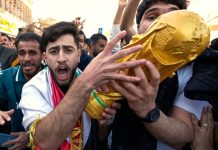


























In Dallas Fort Worth airport, a group of Iraq supporters celebrate as they transit for a flight home after attending a glorious World Cup playoff success in Mexico. They sing a little and wave their national flag. You might be able to picture it, if you have ever seen footage of literally any international football match in history.
The video is grainy and the phone is pointed downwards after a while, but the gist is clear. An American man in a bright orange shirt and baseball cap shouts: “Don’t come to America. You don’t come to America and do that”. Someone should probably explain what a World Cup is quickly, because he’s going to have a bad summer.
It is one incident, one bad bloke who was led away by security staff. But one group of people who feel threatened is one too many and this is a microcosm of the concerns now enveloping the World Cup this summer, at least for those supporters travelling to the US. It is a question that so many immigrants there have asked themselves already: is this safe for me?
This could be the World Cup of geopolitical hostility. For the first time in history, it is eminently possible that the host nation could be at war with one of the competing countries. For all of you still checking your Peace Prize satire monitor, it’s about to explode.
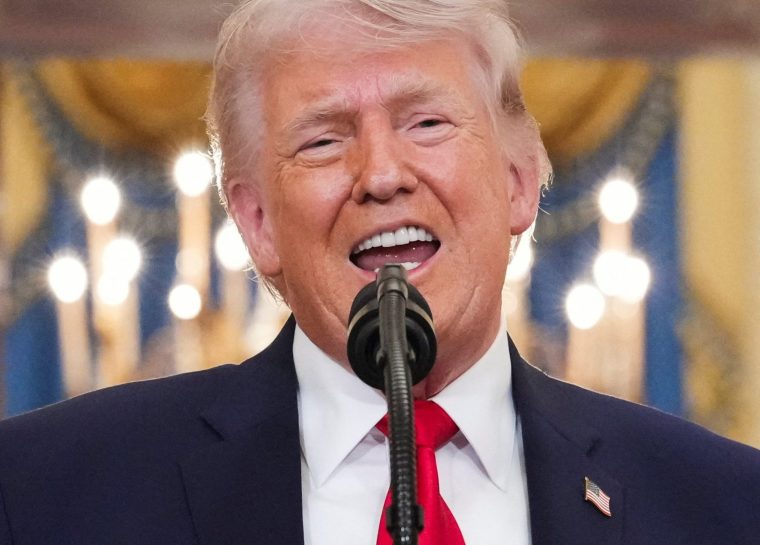
We do not yet know if Iran will be at a major tournament that begins in two months. In a perfect piece of dark comic theatre, President Trump says that they shouldn’t come to the US, Iranian Sports Minister Ahmad Donyamali says that they can’t come to the US and Fifa president Gianni Infainto says that they will come to the US. Marvellous.
But as the Dallas incident shows, it may also be the World Cup of dismal rhetoric. There are real fears for the experience – and even safety – of those travelling from Middle Eastern nations to areas of high and fevered Trump support. Not least because the President chooses to fan those flames of discord at so many opportunities.
Ordinarily, football may be able to escape the heaviest fumes of geopolitical strife with Fifa selling itself as the unifying, apolitical force. In Russia in 2018, there were mass pre-tournament warnings of hooliganism and the treatment of LGBTQ+ supporters, but almost all who went said that the experience was better than they expected.
In Qatar, the treatment of migrant workers and the social laws that made being LGBTQ+ a largely appalling experience again received necessary, appropriate media coverage and criticism and many felt unable to travel as a result. Again, the tournament largely existed in its own bubble. A WorldCupLand is created, a construct that dissuades greater scrutiny.
The US is different. It is far more vast than Qatar, and so harder to control. It is more geopolitically active than Russia in 2018, where Vladimir Putin understood the logic in putting on a show having won presidential elections by a landslide in March of the same year.
Read more
Daniel Storey: Chelsea’s gross rule-bending must make Everton and Forest feel like fools
Daniel Storey: England have a serious Harry Kane problem
The turmoil for supporters is exacerbated by the other, less internationally significant but still personally meaningful issues. This week, the first open sale of World Cup tickets showed that Fifa is charging up to £8,333 for a ticket to the final on June 19. Fifa has defended its pricing structure, but supporters across the board have expressed their deep reservations. Football Supporters Europe, one major fan group, described prices as a “monumental betrayal”.
This is the antithesis of what the 2026 World Cup was supposed to be: a show of unity, the first time a tournament had been held across a continent; a safer choice after the controversies of bidding processes for Russia and Qatar; a made-to-measure tournament using stadia already fit for purpose. In 1994, the US marketed their World Cup as “the greatest show on earth”. This was supposed to be a repeat.
Fear rushes into the cracks created by uncertainty. We are 10 weeks out from the biggest World Cup in history and we don’t know if every country will be there, if supporters from every country will be allowed in, how they will be treated when they get there and how on earth they can afford it. It would be weirder if we weren’t fearful.