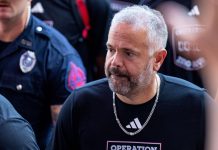






















Tom Dundon’s first weeks as Portland Trail Blazers owner quickly became a flashpoint, not for basketball decisions on the court, but for how the franchise was being run behind the scenes. After purchasing the team for $4.25 billion on March 30, 2026, Tom Dundon stepped into one of the NBA’s most scrutinized roles, only to see the early narrative shift toward controversy, criticism, and questions about his approach to running a modern basketball organization.
“I just made a mistake. I just don’t understand the league,” Dundon said on the Game Over podcast with Max Kellerman and Rich Paul. “In hockey, we don’t travel extra people, because we’re not on vacation. We’re here to win, so we don’t want a distraction. The NBA seems to live with those distractions. It’s not how I think about it. So, you’ve got to learn what the differences are between the two leagues.”
That criticism centered on a series of reported cost-cutting and operational decisions that drew attention across the league. Among them was the decision not to allow two-way players Caleb Love, Chris Youngblood, and Jayson Kent to travel with the team for the first two games of Portland’s first-round playoff series against the San Antonio Spurs.
Separately, reports indicated that during the Play-In Tournament, staff were instructed to check out of hotel rooms by 12:30 p.m. to avoid late fees – an arrangement that reportedly left the team’s masseuse without a private space to treat players. The organization also drew notice for not distributing free playoff T-shirts to fans, a common practice across the NBA during postseason home games.
Together, the decisions shaped an early storyline around Dundon’s ownership: a cost-conscious approach colliding with the expectations, and norms, of an NBA franchise operating on the playoff stage.
Tom Dundon said it was a “mistake” to not send 2-way players on the road. He said Blazers spend $100 million more than the Hurricanes. From his interview on the Game Over pod:
“I’m just not gonna waste $100 million just because someone wants to write an article calling me cheap” pic.twitter.com/pjsan5zk6S
— Mike Vorkunov (@MikeVorkunov) May 16, 2026
On the organizational side, GM Joe Cronin offered his own account of events. Cronin said the two-way player travel situation was the result of a miscommunication on his end, not a directive from Dundon, and confirmed the team corrected course by bringing the players to San Antonio for Game 5. Dundon also offered a broader context on his approach to spending.
“I just don’t want to waste money. I want to invest it,” Dundon said.
“I’ll have many masseuses. I’ll have the best food. We’re going to take care of the players because it helps you win. It’s part of the deal. Some of the stuff about how we’re going to run the business; Portland spends $100MM more a year on their business than the Hurricanes do, not including players.”
Tom Dundon also addressed the Hotel checkout incident
One report that drew attention during Portland’s playoff run centered on a hotel arrangement during the team’s trip to Phoenix. Dundon disputed the idea that this reflected mismanagement, describing it instead as a constraint-driven scheduling decision tied to availability and cost pressures.
“Normally, when you travel, you get late checkout, right? In this case, in sports, it’s usually like 5% and never comes up. Because it was last-minute – going to Phoenix, there was no hotels – I guess Phoenix in March is a pretty popular place. So, I had trouble getting hotels,” he added.
“And the hotel really wanted us to be out early because they needed the rooms.” And so, they wanted us to pay for a second night. And so, we did that for the coaches and the players. But we got (them) to let us leave at 1 o’clock. And I had a room at the hotel. I was there.”
What makes this incident stand out from the other reported incidents is that Dundon did not categorize it as a mistake, the way he did with the two-way player travel situation. Instead, he held his position, suggesting the hotel policy reflects a deliberate operational standard he intends to carry forward, not a one-time misstep born from unfamiliarity with the league.
“I would do it again. I think it’s actually pretty stupid to think that people who are there to work, who are being fed, and 45 minutes later, they weren’t in the lobby, they brought their bags down in the room right by where the bus was, right next to my bag. And we sat down there and talked. And if that’s too hard for people, I’m not right for them. I want that culture.” He said.
When Dundon arrived, Carolina was one of the league’s most stagnant franchises. The Hurricanes had missed the playoffs for nine straight seasons, regularly finishing near the bottom of the standings and struggling to draw consistent crowds. By the time of the sale, the team had become something closer to a cautionary tale than a contender.
What followed under Dundon, however, was a sharp reversal. Over the next several seasons, Carolina shifted into sustained competitiveness: multiple division titles, seven straight playoff appearances, and repeated deep postseason runs that included three trips to the Eastern Conference Final and roughly a dozen playoff series wins. The franchise’s identity changed just as noticeably off the ice, with attendance and performance both trending upward.
The contrast helped define Dundon’s operating style. He has consistently prioritized spending on the roster itself. Often pushing the salary cap or operating right at its edge, while trimming costs elsewhere in the organization. In his view, the money that matters is the money tied directly to wins on the ice.
That philosophy has produced a split perception. On one hand, Carolina has become a model of sustained contention in the post-salary-cap NHL era. On the other hand, Dundon’s willingness to cut spending in business-side operations – changes to broadcasting, staffing adjustments, and other overhead reductions has fueled a reputation for austerity in areas beyond player performance.
It is a reputation that now follows him into Portland, where early decisions have already revived familiar questions about where efficiency ends, and excess caution begins.
With the Blazers’ season now over, the organization’s attention turns to finding a permanent head coach — and that process has generated its own share of discussion.
Reports emerged suggesting Dundon was looking to pay no more than $1.5 million annually for a new head coach, which would place the Blazers’ coach among the league’s lowest-paid.
That figure aligns more closely with what top assistant coaches typically earn than with what head coaches earn in the current market.
Some experienced coaches, including Michael Malone and Tom Thibodeau, reportedly declined to engage when Portland reached out early in its search.
Who do you think will become the head coach?