

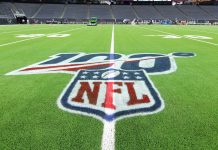































Grass fields versus artificial turf debate has been going on since Houston installed the first artificial turf in 1966. Players have repeatedly demanded softer, high-quality grass be the safer option for the fields, with fewer injury risks. But the NFL officials have been pushing the argument aside. And while JC Tretter, the director of NFLPA, restarted the movement to bring the grass back, Pat McAfee came forth with a different perspective.
Tretter’s argument revolved around the nine NFL stadiums installing high-quality grass in the field in order to host the 2026 FIFA World Cup. But the NFL players have been asking for the same for ages. The NFLPA even conducted a poll with 1,700 players, and 92% of them stuck with grass fields. They believed that grass has a lower impact on the body than artificial turf. But the disappointment came with the premonition that the grass would be removed by the time the regular NFL season started. It certainly infuriated many as they criticized the special treatment for soccer.
Surprisingly, McAfee, in the latest episode of The Pat McAfee Show, projected a different reality, sharing the perspective of JJ Watt. He said, “Soccer grass is obviously different. It’s a little lighter; it’s a little softer. It’s meant for running. Not so much like pushing and all that stuff. So, the grass that’s going into these stadiums is nowhere near what football grass would inevitably have to be anyway. So, there’s always a constant deflection by the NFL.”
The reason behind the constant deflection is the different nature of football and soccer. While soccer demands only running and sliding, football demands more physical contact. Football fields must withstand greater torque and push. And turf might be a bit harder, but it doesn’t break or snap under tension as the NFL players tackle and push against each other.
Instead of investing the necessary capital to develop and maintain football-specific natural grass, the owners focus on why the soccer pitch won’t work. The argument allows them to maintain the status quo while still reaping the massive financial benefits of hosting international events.
NFL players strongly want high quality grass fields..
NFLPA executive director JC Tretter is continuing to push for it #PMSLive pic.twitter.com/nXD9XYVGeF
— Pat McAfee (@PatMcAfeeShow) May 13, 2026
The former punter continued, “Soon as the players say this about the World Cup soccer grass, the NFL goes like, ‘You guys want that grass? If we put that grass in every single stadium, your guys’ argument would look terrible because it would be the worst that we have.’”
But then, it’s also about business. NFLPA leadership has repeatedly raised concerns about multi-use stadium economics. They host events like concerts and monster truck rallies to generate massive revenue. However, these events also damage the field. And while the owners get the financial benefits, the players get physical consequences. That’s one of the major reasons why the debate keeps on resurfacing.
Interestingly, there’s also a proven science behind why grass is better suited for NFL players than turf.
Science behind the demand for natural, high-quality grass fields over artificial turf
The very reason behind the NFL’s deflection is that grass fields are safer for the players. Tretter even conducted a study between 2012 and 2018, revealing a 28% higher rate of incidence of non-contact lower-extremity injuries on turf. And that clump of injuries included more knee injuries (32%) and more foot and ankle injuries (69%) on turf.
“First, a bit of physics: Professional football players put extremely high levels of force and rotation onto the playing surface,” Tretter claimed. “Grass will eventually give, which often releases the cleat prior to reaching an injurious load. On synthetic surfaces, there is less give, meaning our feet, ankles, and knees absorb the force, which makes injury more likely to follow.”
A prospective two-cohort study from 2006 (British Journal of Sports Medicine) had a similar inference. Over 1,000 match hours, the researchers observed that the risk of ankle injuries increased on artificial turf. That certainly demands more attention from the authorities. But they also found that the cohort playing on the artificial turf had lower injury incidence during match play. The rate ratio was 0.66 with a 95% confidence.
Meanwhile, another study from 2024 (Hawaii Journal of Health and Social Welfare) analyzed the impact of deceleration differences between the two field types. Being the firmer and harder surface, turf obviously showed a significantly greater impact deceleration. This means the players can come to an abrupt stop from a run on turf. But on grass fields, the tension moves to the softer parts of the grass and breaks them. This results in sliding or slipping while trying to come to an abrupt stop.
But in the end, it all comes down to what the players need. And right now, they need safer playing grounds. Dion Dawkins, through USA TODAY Sports, claimed that mishaps on turf tend to feel like rubbing on sandpaper. There’s more friction and more bruises than on grass. But then again, the NFL demands more contact and action than soccer, making the officials prefer turf over grass.