









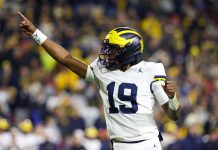









While Texas QB Arch Manning enters the 2026 season as a Heisman co-favorite with odds around +550 to +800, Michigan QB Bryce Underwood is viewed as a “high-upside” shot with odds around +3000 to +3500. Despite that, Underwood can surpass Manning if only one specific thing is within the Wolverines’ QB1’s control.
In 2025, both Manning and Underwood faced high drop rates that significantly hampered their production. While Texas fans were frustrated by the 22 drops Manning endured, an analysis by CBS’s Tom Fornelli labeled Underwood as one of the “unluckiest” QBs in the country, citing similar struggles at Michigan. Fornelli ranked the QBs by the difference in completion rate, adjusted for drops.
Surprisingly, Tulane’s Jake Retzlaff didn’t top the list despite having 31 dropped passes last year. That was purely because of the number of passes he attempted. Appalachian State’s AJ Swann was the No. 1 QB on Fornelli’s list. If his receivers had caught the passes they dropped, Swann’s completion rate would have improved by 5.76%. The second on the list is Bryce Underwood, whose receivers dropped 15 passes. That decreased his completion rate by 5.50%. Manning didn’t make it to the top 15.
Fornelli also looked at the other side of the drops—QBs whose receivers catch the passes. In that regard, Julian Sayin and Fernando Mendoza were the luckiest. Their completion rate was affected by just 1.18% and 1.19%, respectively, by the drops. The lesson is simple. If you want to make it to the Heisman ceremony, your receivers must catch your passes.
In Underwood’s case, the former No. 1 overall recruit had an uneven true freshman season, throwing 11 TDs against 9 interceptions. But analysts like Kirk Herbstreit predict a “massive jump” in 2026 under new head coach Kyle Whittingham and OC Jason Beck.
The Michigan QB now has a specific position coach, Koy Detmer Jr., who was missing during 2025. Although Manning’s last season performance was better than Underwood’s, some experts, like Joey Galloway, have argued that Underwood is already “better” in terms of timing and poise, given his age. His ability to account for nearly 400 rushing yards as a freshman also gives him a dual-threat edge over Manning.
There are a lot of things a QB can control. One thing he can’t is whether his receivers catch the damn ball.
I looked at last season’s numbers to see which QBs were luckier than others in that department. https://t.co/fGuRteMzn3 pic.twitter.com/sqyMin4ueA
— Tom Fornelli (@TomFornelli) May 5, 2026
However, to help Manning, Texas added Cam Coleman, an elite transfer from Auburn known for a wider catch radius. Because of his consistency and the elite talent Texas has surrounded him with, Manning is the projected No. 1 overall pick for the 2027 NFL Draft. Meanwhile, Michigan is hoping for a “sophomore jump” from its young receiving corps under Kyle Whittingham to ensure Underwood’s on-target throws actually count.
If Michigan’s new-look WR room helps eliminate the drops, Underwood, who is widely viewed as the “future of college football,” could take the crown.
Does Bryce Underwood have enough talent around him?
The Michigan WR room for 2026 is widely considered much better than in 2025, with analysts describing it as the roster’s “biggest glow-up.” While sophomore Andrew Marsh returns as a proven star, Michigan landed two massive transfer targets: Jaime Ffrench from Texas and JJ Buchanan from Utah.
Beyond Buchanan, Michigan is incorporating Jamar Browder (6’5″) and true freshman Travis Johnson (6’4″), both of whom provide large catch radii to mitigate slightly off-target “velocity” throws from Underwood. Then there’s Salesi Moa, a top recruit who followed Whittingham from Utah; the coach remarked that he has “looked sharp” in workouts and is part of a “ready-made” freshman class capable of helping immediately.
To help the new receivers adjust quickly, Whittingham and OC have implemented a “user-friendly” scheme that isn’t steep to learn, allowing players to play fast right away. Now, let’s see how Bryce Underwood performs with these weapons and how this season unfolds.