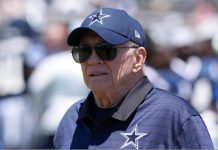






The 2010 season was supposed to be a free market for the NFL franchises. The old CBA had expired, and for the first time since 1993, no salary cap was in place. Teams had the liberty to structure contracts however they wanted. But that rule didn’t play out too well for Jerry Jones’ Dallas Cowboys and one other franchise.
Dallas used the cap opening to restructure wide receiver Miles Austin’s $54 million contract, pushing $17 million of cap charges into that year. The Washington Redskins did the same with defensive tackle Albert Haynesworth’s $100 million deal alongside cornerback DeAngelo Hall’s contract. They front-loaded a combined $36 million worth of cap. All of those contracts went through the league for review and got approved. Happy ending, right?
In March 2012, two years after the fact, the league announced penalties. Dallas lost $10 million in future cap space, and Washington lost $36 million. The $46 million total was redistributed equally among 28 other clubs. The committee that made those calls was chaired by New York Giants owner John Mara, whose team also belongs in the NFC East, the same division as both the Redskins and the Cowboys. Mara didn’t pretend to be neutral at the time.
View this post on Instagram
“What they did was in violation of the spirit of the salary cap,” Mara had said at the time. “They attempted to take advantage of a one-year loophole … full well knowing there would be consequences.”
In May 2012, the union escalated. This punishment, which the NFLPA viewed as concrete evidence of the league enforcing a secret salary cap, directly led the union to file its billion-dollar lawsuit for collusion. The NFLPA filed a federal lawsuit in Minneapolis against the NFL, alleging that the league had operated a secret $123 million salary cap during the uncapped year and that this arrangement cost players more than $1 billion in wages they were owed. The lawsuit also sought $3 billion in additional damages for violating the 1993 White Agreement, which created the original free agency.
“When the rules are broken in a way that hurts the game, we have an obligation to act,” NFLPA executive director DeMaurice Smith had said at the time. “We cannot stand by when we now know that the owners conspired to collude.”
A federal judge dismissed the case in September 2015. The court ruled that there could be no case against the NFL since the NFLPA had entered a new CBA in 2011. Every legal avenue was closed from there.
As for Jerry Jones, he paid for it on the field. Cap-strapped and unable to retain their roster, Dallas released DeMarcus Ware in March 2014. Ware had spent nine seasons in Dallas, creating the franchise record of 117 sacks. He signed with the Denver Broncos that year, stayed until he won Super Bowl 50, and retired as a Cowboy in 2017. Washington, hit with the larger penalty, went 3-13 in 2013.
The oral warnings the league pointed to had never been formalized, never put into the CBA, and never distributed in writing. The league approved every single contract at the time and came back with punishments later. A rival owner ran the committee, and no one ever questioned that specific arrangement.
That 2012 fight wasn’t the first time Jones had clashed with the league. Five years later, he picked another fight, one that cost him again.
Jerry Jones’ 2017 battle with the NFL
In August 2017, NFL Commissioner Roger Goodell handed running back Ezekiel Elliot a six-game suspension after a domestic violence investigation. Jerry Jones publicly called it an “overcorrection.” During that time, he was also sitting on the NFL’s compensation committee, the six-owner group that was negotiating Goodell’s contract extension.
Jerry was supposed to be the unofficial, non-voting seventh member. He threatened to sue unless the committee canceled the extension. But they removed Jerry from the committee instead. The compensation committee of owners issued Jones a cease-and-desist. The league was also reportedly exploring penalties: fines, suspension, or even forcing a sale of the franchise. But Jones never filed anything despite his threats.
Once again, though, the matter wasn’t over. By February 2018, the NFL was pushing to get more than $2 million from Jones as compensation. This was for the legal fees other owners had run up defending against his threats. The decision was approved by the league’s finance committee and brought about by fellow owners, not Goodell.
There’s another massive battle, which Jones actually won, that we must also explore here. Back in 1995, Jones started signing his own stadium sponsorship deals with brands like Nike, Pepsi, and American Express. But this bypassed NFL Properties, which controlled all league-wide marketing revenue and split it equally. NFL Properties sued JJ for $300 million.
But Jones didn’t stay quiet. He countersued for $750 million, arguing that the league’s rules were in violation of antitrust laws. The league ultimately settled, and Jones kept his deals. That agreement opened the door for every other franchise to pursue its own stadium sponsorships and changed the business outlook of the NFL forever.
Jerry Jones beat the NFL in 1995 because his antitrust argument was too dangerous to take to trial. He lost in 2012 because the league had already written the exit into the new CBA. He made noise in 2017, got removed from the room, and ended up on the hook for $2 million. Each time, the league has controlled the process. That’s always been the point.