




















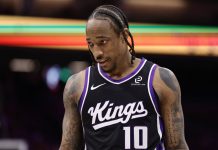














Just as DeMar DeRozan inches closer to one of the most exclusive scoring clubs in NBA history, one analyst managed to turn that achievement into controversy, calling it “deeply disturbing.”
DeMar DeRozan only needs to average 18 PPG for another 105 games to surpass Shaq in career points and enter the all-time Top 10
I find this deeply disturbing
— Carson Breber (@Carsobi) April 9, 2026
Breber’s words created a great controversy on Twitter (with 1.8 million people viewing the comment), and it even garnered the attention of the man in question.
DeRozan actually fired back with a couple of responses, the first of which wasn’t exactly kid-friendly. But minus the swear words, he said, “Disturbing!? Fu*k that mean? Who the hell is you to have an opinion on somebody career. Clown!”
He then followed it up with a second jab:
And it’s weird you live behind a computer, dweeb!
— DeMar DeRozan (@DeMar_DeRozan) April 9, 2026
The tweet deserves scrutiny for several reasons, starting with the fact that DeRozan has spent the entire season stuck on a 22-59 Kings squad that sits at 14th in the Western Conference. He hasn’t exactly been part of many serious conversations this season.
And to be clear, no serious argument places DeRozan in the same tier as Shaquille O’Neal. It would be one thing to push back on a casual fan misreading the all-time list and assuming they were of the same caliber.
In reality, it seems Breber was just looking to unnecessarily stir the pot for the sake of engagement and a larger Twitter following, which feels unnecessary, especially considering how open DeRozan has been about mental health throughout his career.
However, if you look at the rest of his account, this seems to be pretty on-brand for Breber:
We ranked the Top 10 defensive peaks in NBA history with @MarzTalksSports… what stands out? pic.twitter.com/uYC0xwoNRs
— Nerd Sesh (@Nerd_Sesh) March 17, 2026
There’s little indication that Breber blends film study with his statistical takes, which often leads to surface-level conclusions. I’m as big of a data dork as anyone, but it has to be paired with film. Breber also tends to claim a high-level understanding of other sports, which can make it difficult to maintain depth across multiple sports, as it is incredibly difficult to gain expertise in more than one sport (have you ever seen Erik Spoelstra try to coach football?).
That is why Breber must resort to taking all advanced stats at face value. It doesn’t take a genius to go on Basketball Reference or Cleaning the Glass (although it does take a five-dollar monthly subscription to visit the latter) and see that in 12 of his 17 career seasons, DeRozan’s teams have been better with him on the bench.
What does require deeper examination, though, is the context behind those numbers. First off, while the Toronto Raptors were consistently better without DeRozan, they were still consistently winning DeRozan’s minutes. From 2013-18, the Raptors were always in the 70th percentile or higher in on-court net rating with DeRozan on the court. In 2017-18, Toronto was in the 92nd percentile in on-court rating in DeRozan’s minutes (+7.5 per 100 possessions).
On-off splits also have a lot to do with team construct. During those years, the Raptors usually had a very strong bench and DeRozan’s co-star at the time (Kyle Lowry) was one of the most underrated players from that era. This meant that Toronto was able to beat up on other teams second units with Lowry and their B-team guys.
For example, Jonas Valanciunas, who started 444 games for Toronto in his seven seasons with the team, yet never had a season with a positive on-off. The same thing is true for Serge Ibaka, who never had a positive on-off in his four seasons with the Raptors (228 games played and 177 starts).
DeRozan played on an equally strong bench when he went to San Antonio (they were fourth in bench points per game in 2019-20). But when his team construct finally changed with the Chicago Bulls, he started to have an on-off footprint more in line with what you would see from an All-Star – placing in the 80th percentile in on/off rating in 2021-22.
While DeRozan’s shot chart is antiquated, he doesn’t get enough credit for transforming his game to become a more effective player in his 30s. DeRozan upped his playmaking and started turning some of his long midrange attempts into short ones (in turn increasing his efficiency), and as a result, he posted two of his three best Offensive Estimated Plus-Minus (OFF EPM) seasons during his age-31 and 32 campaigns (per Dunks & Threes).
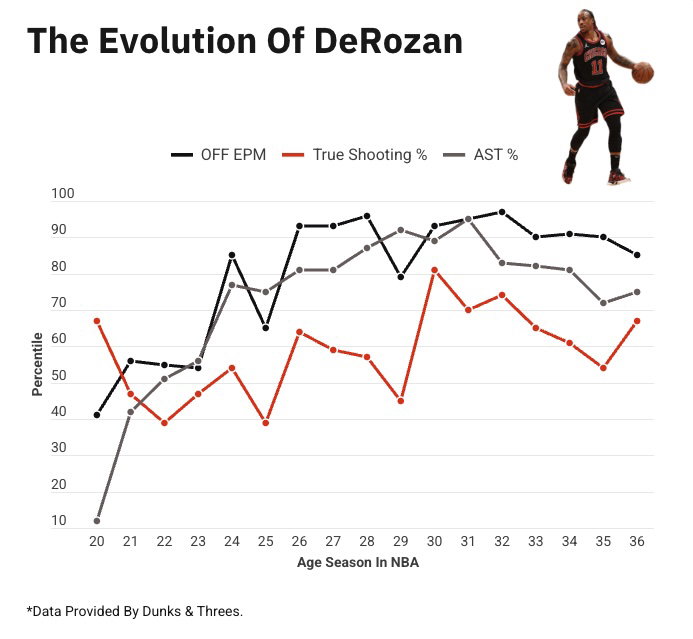
Notice how not once in this article did I cite the beauty of how DeRozan scores. That alone is enough to warrant DeRozan being remembered by future generations, in the same way we remember the Bernard Kings and Mitch Richmonds of the world (two beloved volume scorers who never achieved true postseason success). But I also wanted to show that there is an “analytical” argument that illustrates how DeRozan has been a very good NBA basketball player for quite some time.
As for the all-time scoring list, of course, players who spent their peak years in the pace-and-space era are going to start to congregate at the top of the list. Today’s game is more efficient and more up-tempo than ever before. Joe Flacco and Kirk Cousins have more career passing yards than Joe Montana. Is that deeply disturbing? Or is it just an example of how much the game has evolved over the years?
When people are comparing scorers from different eras, they should use pace/efficiency-adjusted scoring stats. Doing this gives O’Neal a slight edge over someone like DeRozan, but analysts chasing engagement don’t seem to include that type of analysis.
The problem isn’t that DeRozan is climbing the all-time scoring list; it’s how we choose to interpret what that climb means in today’s NBA. This time, though, the noise didn’t win; the context did.