
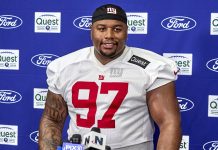




















Once Dexter Lawrence reportedly requested a trade from the New York Giants, the speculation didn’t take long to follow. One of the first teams linked was the Chicago Bears. But as quickly as that narrative picked up, it also faced pushback as the former Giants executive Greg Gabriel shut it down.
“I worked for the Giants for 17 years and still have several friends that are very high in the chain of command,” Gabriel wrote on X. “First, Dexter Lawrence is not available and second the Bears DID NOT inquire. These are typical engagement posts that wanna be’s put out for views. Happens all the time. Do not pay attention to them.”
Yesterday @davebftv posted that the Bears have reached out to the NYG about Dexter Lawrence. His “info” came from @Easton__Butler who is a known Bears troll and not anyone who knows anything.
I worked for the Giants for 17 years and still have several friends that are very high…— Greg Gabriel (@ggabefootball) April 7, 2026
That response came just a day after Adam Schefter reported that Lawrence had requested a trade and would skip the team’s upcoming offseason program. Naturally, that opened the door for league-wide speculation. Multiple reports quickly connected Chicago as a potential landing spot, but Gabriel directly called out names like Easton Butler and Davebftv, insisting the interest simply isn’t real.
Now, his first claim that Lawrence is not available feels debatable given the trade request itself. But his second point carries more weight. There is a difference between a player being discussed and a team actually making a call. And right now, there is no confirmed indication that Chicago has formally reached out.
Still, the logic behind the speculation is easy to follow. The Bears gave up 2,287 rushing yards at 5.0 yards per carry in 2025. That is a structural issue in the run defense, not a minor gap. A player like Lawrence directly addresses that weakness. So, from a roster-building perspective, the link makes sense even if it is not grounded in reality yet.
But then you flip the lens to New York. The Giants were 31st in run defense themselves. Even with Lawrence coming off a down year, moving him now creates another hole in an already struggling unit. That context matters explains why Gabriel believes the team is not actively shopping him despite the request.
There is also the value conversation. A year ago, Lawrence might have commanded multiple first-round picks. Now, according to Jordan Raanan, the expected range is closer to a late first or a second. That shift changes how teams approach negotiations, and it increases the likelihood of competition if he is truly available.
So where does that leave things? Somewhere in the middle. Gabriel is pushing back on the noise, but the underlying factors still keep the door slightly open. For now, what is confirmed is this: Lawrence has made his stance clear. What happens next depends less on speculation and more on whether the Giants are actually willing to move him.
Dexter Lawrence either seeks a value he deserves or a way out of New York
Back in February, John Harbaugh made his stance on Dexter Lawrence very clear. The Giants’ head coach didn’t just call him important. He framed him as the “middle-stone” of the defense, explaining:
“How important is he (Lawrence)? He’s super, super important. He’s a cornerstone football player…not really a cornerstone, more like the middle stone. He’s right in the middle. He’s a very big stone, and he’s a very active, athletic one.”
From a contractual standpoint, the situation explains a lot. The Giants had extended Lawrence on a four-year, $87.5 million deal with $60 million guaranteed, per Spotrac. Then, ahead of the 2024 season, they restructured it to create $7.5 million in cap space by converting $10 million of his base salary into a signing bonus after entering the offseason over the cap.
Now, the structure has shifted. There is no guaranteed money left, and Lawrence is looking for a deal that reflects his current value. That becomes more relevant when you consider recent contracts around the league, where players like Milton Williams and Jordan Davis have landed deals averaging around $26 million per year.
That gap is essentially where the tension lies. Lawrence is coming off three Pro Bowl selections and two Second-Team All-Pro nods, which supports his case. But at the same time, his 2025 season complicates the picture.
He finished with just half a sack, eight quarterback hits, and an 8.3% pass rush win rate while the Giants went 4-13. That dip gives the team leverage in negotiations, even if it doesn’t fully reflect his overall impact.
So this is where things stand. A player seeking value, a team weighing recent production against long-term performance, and a contract structure that no longer offers security. Whether this ends in a new deal or a trade now depends on how both sides interpret that balance in the coming days.